Burnout Recovery: A Four-Week Nervous System Reset for Exhausted Professionals
That familiar hum of exhaustion behind your eyes, the feeling that you’re running on a hamster wheel that just keeps speeding up—it’s more than just being tired. For many of us in demanding profession
That familiar hum of exhaustion behind your eyes, the feeling that you’re running on a hamster wheel that just keeps speeding up—it’s more than just being tired. For many of us in demanding professional roles, it’s the slow, creeping fog of burnout. It’s a state where your body and mind get stuck in “on” mode, your nervous system constantly braced for the next threat, whether it’s a looming deadline or a difficult conversation. But recovery isn’t about finding a new productivity hack or simply pushing through. It's about a gentle but profound reset. It’s about understanding that our bodies have a natural, biological process for dealing with stress, and we’ve simply forgotten how to complete it. Over the next four weeks, we’ll walk you through a step-by-step guide to help your nervous system find its way back to baseline, teaching you not just to cope, but to truly recover. 🌱
[[IMAGE:fig1|A calm, modern illustration of a human silhouette with a glowing, intricate nervous system inside, set against a soft, gradient background of dawn colors.|A stylized human figure stands peacefully. Inside their transparent outline, a beautifully detailed nervous system glows softly. The background is a serene gradient of warm orange, pink, and soft blue, suggesting a sunrise and a new beginning.]]
Here is a quick overview of the steps we'll take on our four-week journey to reset your nervous system and begin healing from burnout.
| Week | Focus | Key Steps |
|---|---|---|
| 1 | Awareness & Gentle Release | 1. The Body Scan & Breathwork<br>2. Mindful Movement |
| 2 | Boundaries & Environment | 3. The "No" Audit & Workplace Scripts |
| 3 | Connection & Creativity | 4. Scheduling Connection & Play |
| 4 | Integration & Sustainability | 5. Crafting Your "Stress-Cycle Menu"<br>6. The Weekly Reset Ritual |
Are You Burned Out? Key Indicators to Watch For
The first step to healing is recognizing the problem. Burnout is a state of emotional, physical, and mental exhaustion caused by prolonged or excessive stress. It’s not a personal failing; it’s a response to chronic environmental stressors. According to the World Health Organization, it’s characterized by three main dimensions:
- Exhaustion: An overwhelming sense of being emotionally drained and physically depleted. This isn’t the kind of tired that a good night’s sleep can fix. It feels bone-deep, a constant lack of energy to face the day.
- Cynicism and Detachment: A growing sense of negativity and distance from your job and colleagues. You might feel irritable, impatient, or find yourself mentally checking out of meetings and conversations. The work that once felt meaningful now feels like a burden.
- Reduced Efficacy: A feeling of incompetence and a lack of achievement in your work. You start to doubt your abilities, and even small tasks can feel monumental. Productivity plummets, not from a lack of effort, but from a lack of capacity.
Underneath these symptoms, your autonomic nervous system is likely stuck in a sympathetic "fight-or-flight" state. Your body is pumping out stress hormones like cortisol and adrenaline as if you're constantly facing a physical threat, leading to everything from digestive issues and headaches to brain fog and anxiety.
The Missing Piece in Stress Management: Completing the Cycle
To truly address burnout, we need to understand the crucial difference between stressors and stress itself. This concept, brilliantly articulated by sisters Emily and Amelia Nagoski in their book Burnout: The Secret to Unlocking the Stress Cycle, is the foundation of our reset.
- Stressors are the external triggers that activate the stress response in your body. Think of a tight deadline, a difficult client, a packed schedule, or a conflict with a coworker.
- Stress is the neurological and physiological response that happens inside you. It's the flood of hormones, the tensed muscles, the quickened breath.
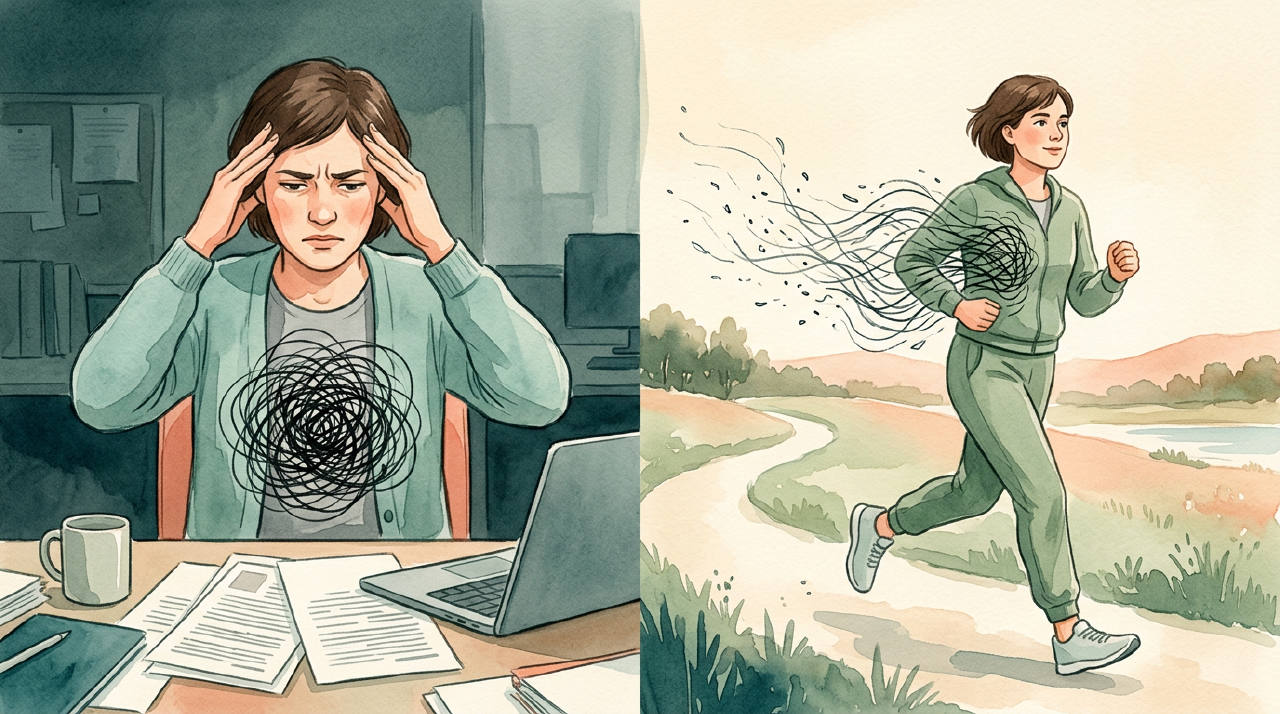
Here’s the problem: we are often very good at dealing with our stressors (we meet the deadline, we handle the client), but we are terrible at dealing with the stress that’s left behind in our bodies. We close the 50 tabs on our computer, but the 50 tabs of stress remain open in our nervous system.
"The stress response has a beginning, a middle, and an end. To be well is not to live in a state of perpetual calm. To be well is to be able to trust that you can move through the whole cycle."
To get “unstuck” and recover from burnout, we must physically signal to our bodies that the threat is over. We have to complete the stress cycle. This guide is designed to help you do exactly that.
Stressors vs. Stress: What's the Difference?
Understanding this distinction is key to your recovery. Managing one without the other is like trying to empty a flooding boat with a bucket without first plugging the hole. You need to do both.
| Aspect | Dealing with the Stressor | Completing the Stress Cycle |
|---|---|---|
| What it is | The external problem or trigger. | The internal physiological response. |
| Example | Your inbox is overflowing with 100 urgent emails. | Your heart is racing, your jaw is clenched, and you feel anxious. |
| Action | Create a plan to triage emails, delegate tasks, set up filters. | Go for a 20-minute brisk walk, have a deep belly laugh, or cry. |
| Goal | To solve, remove, or reduce the external demand. | To release the pent-up energy and signal safety to your body. |
| Outcome | The problem is managed for now. | Your nervous system returns to its baseline resting state (homeostasis). |
Your Four-Week Nervous System Reset: A Step-by-Step Guide
This program is designed to be gentle and cumulative. Don't worry about perfection; focus on consistency and self-compassion. Each week builds on the last, helping you create a sustainable practice of nervous system care.
WEEK 1: Awareness & Gentle Release
This week is about tuning in and introducing your body to the feeling of completing the cycle in small, manageable ways.
Step 1: The Body Scan & 2-Minute Breathwork
- Estimated Time: 10-15 minutes daily
- Required Tools: A quiet space, a comfortable chair or mat
- Key tip: The goal isn't to feel "good," it's just to feel. Notice tension without judging it.
Start each day by sitting or lying down. Close your eyes and mentally scan your body from your toes to the top of your head. Where are you holding tension? Your jaw? Your shoulders? Your stomach? Just notice. Then, practice a simple breathing exercise to signal safety to your nervous system. Inhale slowly for a count of four, hold for a count of four, and exhale slowly for a count of six or eight. The elongated exhale is a powerful biological cue to activate the parasympathetic "rest-and-digest" system. Do this for just two minutes. 💧
Step 2: Mindful Movement to Complete the Cycle
- Estimated Time: 20-30 minutes, 3-4 times this week
- Required Tools: Comfortable clothes
- Key tip: The intensity doesn't matter as much as the intention. The goal is to move your body enough to feel a shift.
Physical activity is the most ancient and efficient way to complete the stress cycle. It tells your body that you have successfully "run from the lion." This doesn't have to mean an intense HIIT workout (which can be over-stimulating when you're already burned out). Try a brisk walk where you swing your arms, a gentle yoga flow, dancing to a few favorite songs in your living room, or even just tensing and releasing all the muscles in your body for a few minutes. Pay attention to how your body feels before and after. 🧘
WEEK 2: Boundaries & External Environment
This week, we shift focus from releasing stored stress to reducing the influx of new stressors by shoring up your boundaries.
Step 3: The "No" Audit & Workplace Scripts
- Estimated Time: 30-minute audit once; practice daily
- Required Tools: A journal or notebook
- Key tip: Saying "no" isn't about being difficult; it's about honoring your capacity. A graceful "no" protects your energy for your most important "yeses."
Spend 30 minutes this week reflecting on your commitments. Where are you consistently over-extending yourself? What requests are you automatically saying "yes" to that leave you feeling drained? Identify 1-2 areas where you can practice setting a boundary. Then, arm yourself with scripts. Having pre-planned phrases makes it easier to respond in the moment.
Helpful Workplace Scripts:
- To delay a request: "Thanks for thinking of me for this. I can look at this after I finish [current priority]. I should be able to get to it by [time/day]."
- To decline a request: "I appreciate you asking, but I don't have the capacity to take that on right now and give it the attention it deserves."
- To delegate or ask for support: "That's an important task. My plate is full with X and Y at the moment. Could [colleague's name] help, or could we look at adjusting the deadline?"
- To protect your time: "I'm focusing on deep work from 9-11 am, but I'll be available to connect after that."
WEEK 3: Connection & Creativity
Burnout thrives on isolation and monotony. This week is about intentionally weaving in two other powerful cycle-completers: social connection and creative expression.
Step 4: Scheduling Connection & Play
- Estimated Time: Schedule one 45-minute social connection and one 30-minute creative session
- Required Tools: Your calendar, a friend, a creative outlet (pen, paints, instrument, etc.)
- Key tip: This must be a "non-productive" activity. The purpose is the connection or creation itself, not a tangible outcome.
Affection and genuine social connection are vital for nervous system regulation. A 20-second hug with a loved one can change your body chemistry for the better. This week, intentionally schedule a coffee, walk, or phone call with someone whose company you genuinely enjoy. Similarly, creative expression—drawing, journaling, playing music, even coloring—allows you to externalize and process emotions without words. It moves the stuck energy out of your body and into the world. ✨
WEEK 4: Integration & Sustainable Rhythms
Now we bring it all together, creating a flexible and personalized toolkit to carry you forward beyond this four-week reset.
Step 5: Crafting Your "Stress-Cycle Menu"
- Estimated Time: 20 minutes
- Required Tools: A journal or digital note
- Key tip: Have options for different contexts. What can you do in 2 minutes at your desk versus 30 minutes at home?
Review the past three weeks. What worked best for you? What activities most effectively helped you feel a sense of completion and release? Create a personalized "menu" of options you can turn to. Categorize them by time commitment.
- Appetizers (1-5 minutes): Deep breathing, shaking out your limbs, a 20-second hug, listening to one loud song.
- Main Courses (20-40 minutes): A brisk walk, a phone call with a friend, a creative session, a good cry over a movie.
- Desserts (60+ minutes): A long hike, a sports game with friends, a big belly laugh with loved ones.
Step 6: The Weekly Reset Ritual
- Estimated Time: 30-60 minutes, once a week
- Required Tools: Your calendar, your "Stress-Cycle Menu"
- Key tip: Make this a non-negotiable appointment with yourself. It's preventative maintenance for your wellbeing. 🕊️
Choose a time each week (e.g., Sunday evening) to perform a reset ritual. This is your time to consciously close the loop on the week's stress. It might involve journaling about your wins and challenges, looking at the week ahead to anticipate stressors and build in recovery time, and choosing one "Main Course" activity from your menu to fully decompress. This ritual creates a rhythm of stress and release, preventing the chronic buildup that leads to burnout.
Visualizing Your Nervous System's Journey
When we don't complete the stress cycle, our nervous system can get stuck in a state of high activation. The goal of these practices is to help your body complete the curve, moving from activation back down to baseline.
Stress Level  ^
              |
              |     /------------------  <-- Stuck in chronic activation (Burnout)
              |    /
              |   /          .... and release  <-- Completing the cycle
              |  /                              \
 Activation -> | /                                \
              |/                                  \
Baseline -----+------------------------------------\-----> Time
                                                 (Rest & Digest)
This chart shows how completing the cycle allows your system to return to a calm, baseline state, while unresolved stress keeps you in a state of chronic, energy-draining activation. 📊
Frequently Asked Questions
What if I miss a day or a week?
This is not a pass/fail exam. It's a practice of self-compassion. If you miss a day, just start again the next. If you have a particularly brutal week and can't do much, that's okay. The goal is to build a toolkit, not to add another stressful "to-do" to your list. Just do one small thing, like three deep breaths. That's a win.
Can I do this program even if I'm not fully burned out?
Absolutely. Think of this as preventative care. Learning to complete your stress cycle is a fundamental life skill, like brushing your teeth. Practicing these techniques when you're feeling relatively good will build your resilience and make it much easier to navigate stressful periods when they inevitably arise. It's an investment in your future wellbeing. 💡
How is this different from just "relaxing" or watching TV?
While passive relaxation like watching TV can provide a temporary distraction, it often doesn't complete the physiological stress cycle. Your body doesn't receive the signal that the "threat" is over. Activities like movement, creative expression, or deep social connection actively engage your physiology to release the pent-up energy and downshift your nervous system, leading to a more profound and lasting state of rest.
When to see a professional
This guide is designed to provide supportive strategies, but it is not a substitute for professional medical or psychological care. If your symptoms of burnout are severe, persistent, or accompanied by feelings of hopelessness, depression, or anxiety that interfere with your daily life, it is crucial to speak with a therapist, counselor, or medical doctor. They can provide a formal diagnosis, personalized treatment plans, and a dedicated space to navigate the root causes of your burnout, including systemic issues within your workplace or personal life.
Your journey back to balance is a deeply personal one. For daily check-ins, guided breathing exercises, and a space to track your progress with gentle accountability, Araam is here to support you every step of the way. 🌿