
9 Research-Backed Ways to Beat Chronic Loneliness in Big Cities
The city hums with a relentless, paradoxical energy. You can be swept along in a river of thousands on a single sidewalk, yet feel utterly, profoundly alone. It’s the flicker of a thousand apartment l
The city hums with a relentless, paradoxical energy. You can be swept along in a river of thousands on a single sidewalk, yet feel utterly, profoundly alone. It’s the flicker of a thousand apartment lights, each one a mystery, a life you’ll never know. This feeling—chronic loneliness in the midst of a crowd—is a quiet epidemic haunting our urban landscapes. It tells you that connection is something that happens to other people, somewhere behind those closed doors or in the warm glow of a restaurant you walk past. But what if connection isn't a matter of chance, but a matter of practice? What if building a life rich with community in a big city is a skill you can learn, one small, research-backed step at a time?

Why Is Urban Loneliness So Common?
Chronic loneliness in big cities often stems from the "paradox of density." With millions of people around, we tend to put up social shields to avoid being overwhelmed, a concept sociologists have explored for over a century. This can lead to a state of "civil inattention," where we politely ignore those around us to maintain our own private space. The transient nature of many cities, with people frequently moving for jobs or education, also makes it difficult to form deep, lasting roots. Furthermore, urban life is often structured around efficiency and individuality, leaving fewer organic opportunities for the spontaneous, low-stakes interactions that build a sense of community. The result is a landscape where we might have hundreds of contacts but lack a true sense of belonging.
9 Research-Backed Ways to Build Connection in the City
Feeling less lonely isn't about suddenly finding a dozen best friends. It's about weaving a richer social fabric, thread by thread. It involves a mix of different types of connections, from the lightest of interactions to deeper bonds. Here are nine practical, evidence-based strategies to combat chronic loneliness and cultivate a sense of belonging in your city.
1. Master the Art of the "Weak Tie"
The foundation of a connected life isn't necessarily a handful of soulmates; it's a wide network of "weak ties." This term, coined by Stanford sociologist Mark Granovetter, refers to your casual acquaintances: the barista who knows your order, the neighbor you exchange pleasantries with, the person you see at the dog park every morning. A 2014 study in the Personality and Social Psychology Bulletin found that people who had more of these small, seemingly insignificant interactions reported a greater sense of happiness and belonging. These light touches of sociability serve as social anchors throughout our day, reminding us that we are part of a living community.
Actively cultivating weak ties can re-wire your brain to see your environment as friendly and familiar rather than anonymous and intimidating. It lowers the barrier to connection, making socializing feel less like a high-pressure performance and more like a natural part of your daily rhythm. Make it a small mission to learn the name of the person at your local corner store or to offer a genuine "have a great day" to the security guard in your office building. These micro-connections accumulate, creating a safety net of familiarity that can significantly buffer feelings of isolation. 🌱
- Best for: Anyone who feels overwhelmed by the idea of making "best friends" and wants to start with low-pressure interactions.
- Pro tip: Create a daily "third-space ritual." Visit the same coffee shop, library, or park bench around the same time each day. Familiarity breeds comfort and opens the door for spontaneous, low-stakes chats with other regulars.
2. Volunteer for a Cause You Believe In
Volunteering is a powerful antidote to loneliness for two key reasons: it provides a shared purpose and facilitates pro-social behavior. When you work alongside others toward a common goal—whether it's cleaning a park, helping at an animal shelter, or serving meals at a soup kitchen—the focus shifts from your own internal state to the collective task at hand. This naturally lowers social anxiety and provides an easy, built-in topic of conversation.
Research from the Journal of Happiness Studies shows a strong correlation between volunteering and improved well-being, including reduced feelings of loneliness and depression. The act of helping others activates reward centers in the brain, fostering a sense of efficacy and value. You are no longer just a resident of the city; you are an active, contributing member of its ecosystem. This sense of mattering is crucial for developing a deep sense of belonging.
- Best for: People who want to find connection through shared values and meaningful action, rather than just social chit-chat.
- Pro tip: Choose a role that requires teamwork. While a solo data-entry task is helpful, a role that involves direct collaboration with other volunteers will be far more effective for building social bonds.
3. Shrink Your City: Explore Your Hyper-Local Neighborhood
A metropolis of eight million people is impossible to comprehend, but a neighborhood of a few thousand is manageable. Beating urban loneliness often involves intentionally shrinking your world to a "village" within the city. This means becoming an expert on your immediate surroundings—the three blocks in every direction from your front door. Swap the big-box store for the local hardware shop, the major chain for the independent bookstore, and the anonymous gym for the neighborhood yoga studio.
When you become a regular patron of local establishments, you transform from an anonymous consumer into a recognized member of the community. You begin to see the same faces, creating a web of weak ties. This strategy, sometimes called "hyper-localism," fosters a sense of place and rootedness. Studies on urban planning and mental health emphasize the importance of "third places"—locations outside of home (the first place) and work (the second)—in fostering community. Your hyper-local neighborhood is full of them.
- Best for: Homebodies or those with limited time who want to integrate connection into their existing daily errands and routines.
- Pro tip: Take on a "15-minute city" challenge. For one week, try to fulfill all of your daily needs (groceries, coffee, exercise) within a 15-minute walk or bike ride from your home. Notice who you see and what you discover.
4. Join a Curated Online Community (Safely)
While mindless scrolling on massive social media platforms can exacerbate loneliness, curated online communities can be a lifeline. The key is to find spaces built around a shared, specific interest, not just passive content consumption. This could be a Discord server for fans of a niche podcast, a Slack group for people in your industry, a subreddit dedicated to a specific hobby like fountain pens or bread-making, or an online book club.
These digital "third places" offer a space to connect with people who truly "get" your passions, which can be difficult to find offline. They allow you to build connections based on genuine affinity rather than just proximity. A meta-analysis published in Cyberpsychology, Behavior, and Social Networking found that online interactions, when they are part of a supportive, well-moderated community, can effectively reduce loneliness and provide valuable social support. The goal is to use these forums not as a replacement for real-world interaction, but as a supplement and a bridge to it.
- Best for: Individuals with niche interests, those with social anxiety, or anyone looking for connection outside of typical business hours.
- Pro tip: Vet the community's culture before diving in. Lurk for a bit to observe the tone of conversation. A healthy online community has clear moderation, encourages positive interaction, and discourages trolling or hostility.
5. Embrace the Power of a "Third Place"
As mentioned, "third places" are the anchors of community life. They are the informal public spaces where people gather, connect, and build relationships organically. In a bustling city, you have to be intentional about identifying and frequenting yours. This isn't just about being a customer; it's about becoming a part of the place's social fabric. It could be a brewery with a communal table, a library with a cozy reading nook, a dog park, a climbing gym, or even a public plaza with good seating.
The magic of a third place is that it removes the pressure to "make a friend." You're there for another reason—to read, work, drink coffee, or exercise. Social interaction is a possible and pleasant byproduct, not the sole, anxiety-inducing goal. Over time, you'll become a "regular," and the staff and other regulars will become your weak ties. These places provide the context and consistency needed for acquaintanceship to potentially blossom into friendship. 🌿
- Best for: People who want to create opportunities for spontaneous connection without the formality of a scheduled event.
- Pro tip: Leave your headphones off (when appropriate). Making yourself approachable is half the battle. Bringing a book, a sketchbook, or knitting can also act as a natural conversation starter.
6. Take a Skill-Based Class
Signing up for a class—be it pottery, improv, coding, or a new language—is a time-tested strategy for a reason. It places you in a room with the same group of people on a regular basis, all working toward a shared goal. This structured environment provides a perfect scaffold for forming new connections. The class itself provides the topic of conversation, breaking the ice automatically.
According to the "mere exposure effect" in psychology, we tend to develop a preference for things—and people—merely because we are familiar with them. The weekly repetition of a class leverages this principle beautifully. You're not just strangers; you're fellow beginners struggling with a pottery wheel or conjugating French verbs. This shared vulnerability and collaborative learning process can fast-track the development of camaraderie and friendship.
- Best for: Goal-oriented individuals and those who feel more comfortable interacting when there's a clear activity or purpose.
- Pro tip: Choose a class that is collaborative and hands-on. A cooking class or an improv workshop will offer more natural opportunities for interaction than a lecture-style course.
"The antidote to loneliness isn’t a party; it’s purpose. It’s the quiet nod from the barista, the shared laugh in a pottery class, the collective effort of weeding a community garden. It's weaving yourself back into the world, one small, intentional thread at a time."
7. Reframe Solitude and Date Yourself
This might sound counterintuitive, but a crucial step in combating chronic loneliness is to learn to differentiate it from solitude. Loneliness is the painful absence of connection. Solitude is the peaceful state of being alone by choice. By learning to enjoy your own company, you reduce the desperate, "needy" energy that can sometimes push others away. It builds self-reliance and makes your social interactions a "want" rather than a "need."
Practice this by scheduling "solo dates." Take yourself to a museum, a movie, or a nice dinner. Bring a book or a journal, but also spend time simply observing the world around you without the filter of a screen. This practice, rooted in mindfulness, helps you become a more interesting person—both to yourself and to others. When you have a rich inner world, you bring more to your relationships when you do form them. 🧘
- Best for: Everyone, but especially those who feel a sense of panic or emptiness when they're alone.
- Pro tip: Start small. A 20-minute solo walk in a beautiful park or 30 minutes in a coffee shop without your phone is a great first step. The goal is to associate being alone with peace and rejuvenation, not lack.
8. Leverage Your Workplace "Proximity"
For many city dwellers, the workplace is the primary place they interact with the same people day after day. While we're often focused on being professional and productive, the office can be a fertile ground for forming connections that go beyond project updates. The principle of "proximity," a cornerstone of social psychology, states that we're more likely to form relationships with people we are physically close to and see regularly.
Make a conscious effort to engage. Instead of eating at your desk, have lunch in the communal kitchen or break room. Join the company's social committee or volunteer for a non-work-related initiative. Ask a coworker about their weekend and actually listen to the answer. These small gestures can transform colleagues from mere work associates into a supportive social network, making your workday more enjoyable and your life feel more connected.
- Best for: People who spend a significant amount of their day at an in-person or hybrid job.
- Pro tip: Be the one to initiate. Simple, low-risk invitations like "I'm grabbing a coffee, can I get you anything?" or "A few of us are trying that new lunch spot on Friday, want to join?" can make a huge difference.
9. Get Your Hands Dirty in a Community Garden
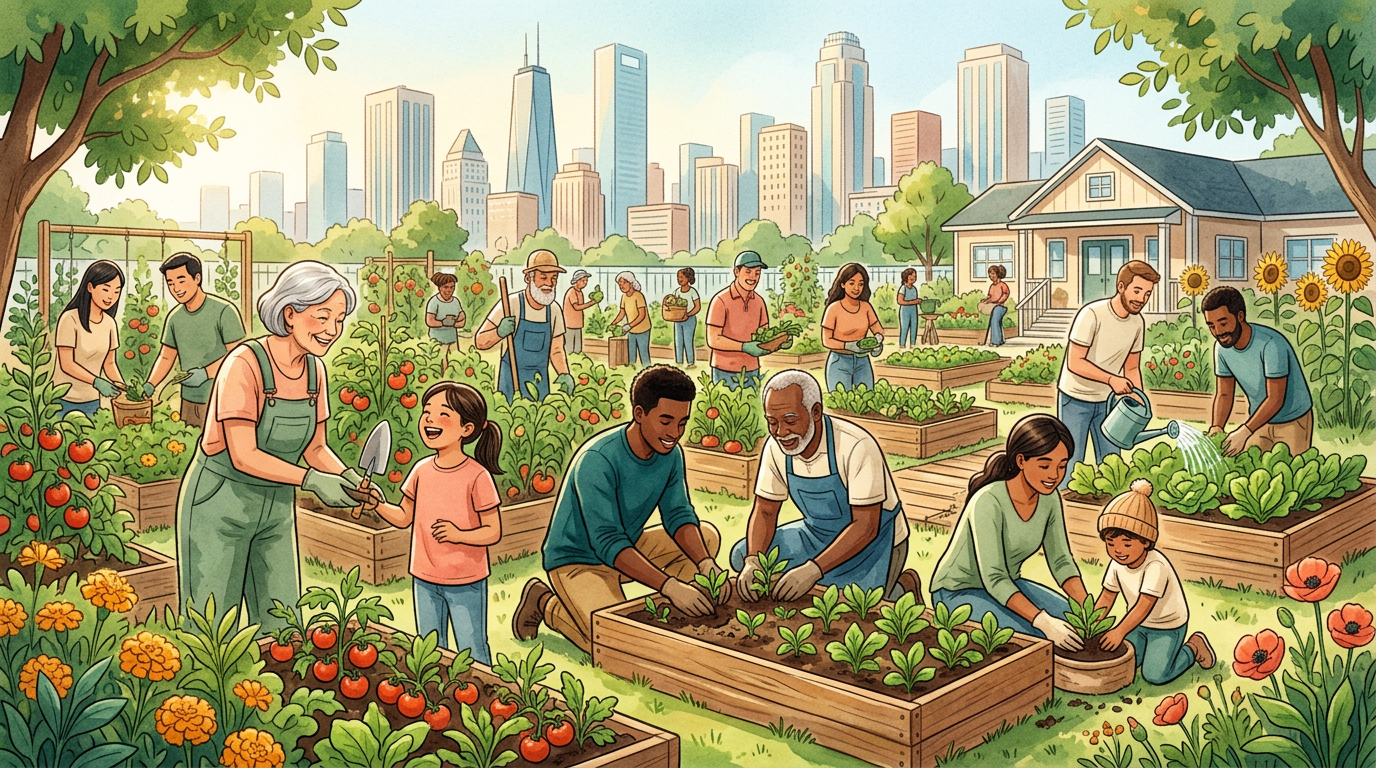
Community gardening is a uniquely powerful tool against urban loneliness. It combines several of the strategies on this list into one activity. It provides a shared purpose (volunteering), gets you interacting with neighbors (hyper-localism), and creates a beautiful "third place." Moreover, it connects you with nature, which has its own profound mental health benefits—a practice known as ecotherapy. 💧
Studies have shown that community gardening is associated with reductions in stress and anxiety, and significant increases in social connections and community cohesion. Working the soil alongside your neighbors, sharing tips on dealing with pests, and celebrating the first tomato of the season creates a deep, embodied sense of belonging. You are literally putting down roots in your community.
- Best for: Nature lovers and anyone who enjoys tangible, visible results from their efforts.
- Pro tip: You don't need a green thumb! Most community gardens are very welcoming to beginners. Many have communal plots where you can learn from more experienced gardeners, or they need help with non-planting tasks like composting or building beds.
Deep vs. Weak Ties: Why We Need Both
Understanding the different types of relationships can help you set realistic expectations. You don't need every acquaintance to become a best friend. A healthy social life is a balanced ecosystem of both deep and weak ties.
| Characteristic | Deep Ties (Your Inner Circle) | Weak Ties (Your Community Web) |
|---|---|---|
| Frequency | Less frequent, but high-quality time | Frequent, brief, and casual encounters |
| Emotional Depth | High. Involves vulnerability, support, shared history. | Low. Involves politeness, shared context, light chat. |
| Purpose | Emotional support, intimacy, life partnership. | Sense of belonging, information exchange, daily joy. |
| Number | Typically small (2-5 people) | Can be very large (dozens or hundreds) |
| Example | A best friend you call in a crisis. | The barista who knows your name. |
The Upward Spiral of Connection ✨
Building a social life isn't a linear process; it's an upward spiral. Small actions build confidence, which leads to slightly bigger actions, creating positive feedback loops that combat the inertia of loneliness.
            +---------------------------+
            |  Small, Low-Stakes Action |
            | (e.g., Say hi to barista) |
            +-------------+-------------+
                          |
                          v
            +---------------------------+
            |    Positive Micro-Reward    |
            | (e.g., They smile back)   |
            +-------------+-------------+
                          |
                          v
+-----------------------+ +------------------------+
|   Increased Confidence  | |  Reduced Social Anxiety  |
|      "That wasn't so bad" | |    "People are friendly" |
+-----------+-----------+ +-----------+------------+
            |                         |
            +-----------+-------------+
                          |
                          v
            +---------------------------+
            |   Willingness to Try a    |
            |   Slightly Bolder Action  |
            | (e.g., Attend a local meetup)|
            +-------------+-------------+
                          |
                          v
            +---------------------------+
            |    Deeper Connection forms  |
            | (e.g., Have a real conversation)|
            +-------------+-------------+
                          |
                          v
                  (Cycle Repeats & Strengthens)
Frequently Asked Questions About Urban Loneliness
Why do I feel lonelier in a big city than I did in my small town?
In a small town, social connections are often built-in and reinforced through repeated, unplanned interactions over many years. In a big city, the environment is more anonymous and interactions must be more intentional. You don't bump into people you know at the only grocery store. You have to actively create those points of connection yourself, which requires more effort and can feel daunting at first.
I'm an introvert. Do these tips still apply to me?
Absolutely. 💡 In fact, many of these strategies are introvert-friendly. Cultivating weak ties, finding a third place, joining a skill-based class, or volunteering allows for interaction in structured, low-pressure settings. It's not about becoming an extrovert; it's about finding sustainable ways to meet your innate human need for belonging in a way that respects your energy levels. The goal is quality connection, not quantity of social interactions.
How long will it take to feel less lonely?
There's no magic timeline, and it's important to be patient with yourself. The goal is to focus on the process, not the outcome. You might feel a small lift after just one pleasant chat with a neighbor (the upward spiral!). Building a deeper sense of community can take months or even a year or two. Celebrate the small wins along the way and trust that these consistent efforts are weaving a stronger social fabric for you over time. Progress isn't linear; some weeks will feel more connected than others, and that's completely normal.
When Your Efforts Don't Seem to Be Enough 🕊️
Making an effort to connect is a brave and important step. However, if your feelings of loneliness are persistent, overwhelming, and interfering with your ability to function or find joy in daily life, it might be a sign of something more. Chronic loneliness can be intertwined with mental health conditions like depression or social anxiety. If these feelings are accompanied by a lack of energy, changes in sleep or appetite, a loss of interest in things you once enjoyed, or intense anxiety about social situations, it may be helpful to speak with a mental health professional. A therapist can provide a safe space to explore these feelings and develop personalized coping strategies.
And if you ever need a space to process these feelings or practice articulating your thoughts before a real-world conversation, remember that Araam is here. Our AI companion is available 24/7 to listen without judgment, helping you navigate the complex emotions that come with building a more connected life.