
A Printable ACT Values Card Template for Monthly Practice
It can be unsettling to feel like you're adrift—moving through your days on autopilot, checking off tasks, and meeting obligations, but without a deeper sense of purpose guiding you. You might find yo
It can be unsettling to feel like you're adrift—moving through your days on autopilot, checking off tasks, and meeting obligations, but without a deeper sense of purpose guiding you. You might find yourself wondering, "Is this it? Am I living the life I truly want?" This feeling of being disconnected from what matters is incredibly common. Acceptance and Commitment Therapy (ACT) offers a powerful antidote: living a life guided by your core values. Think of your values as a compass, always available to point you toward your personal "true north." But a compass is only useful if you consult it. This is where a simple, tangible tool comes in: a monthly values card. It’s a personal, printable reminder of what you stand for, designed to help you navigate life's complexities not by avoiding discomfort, but by moving toward what enriches and fulfills you, one small, committed step at a time. 🌱

What is an ACT Values Card and Why Use One?
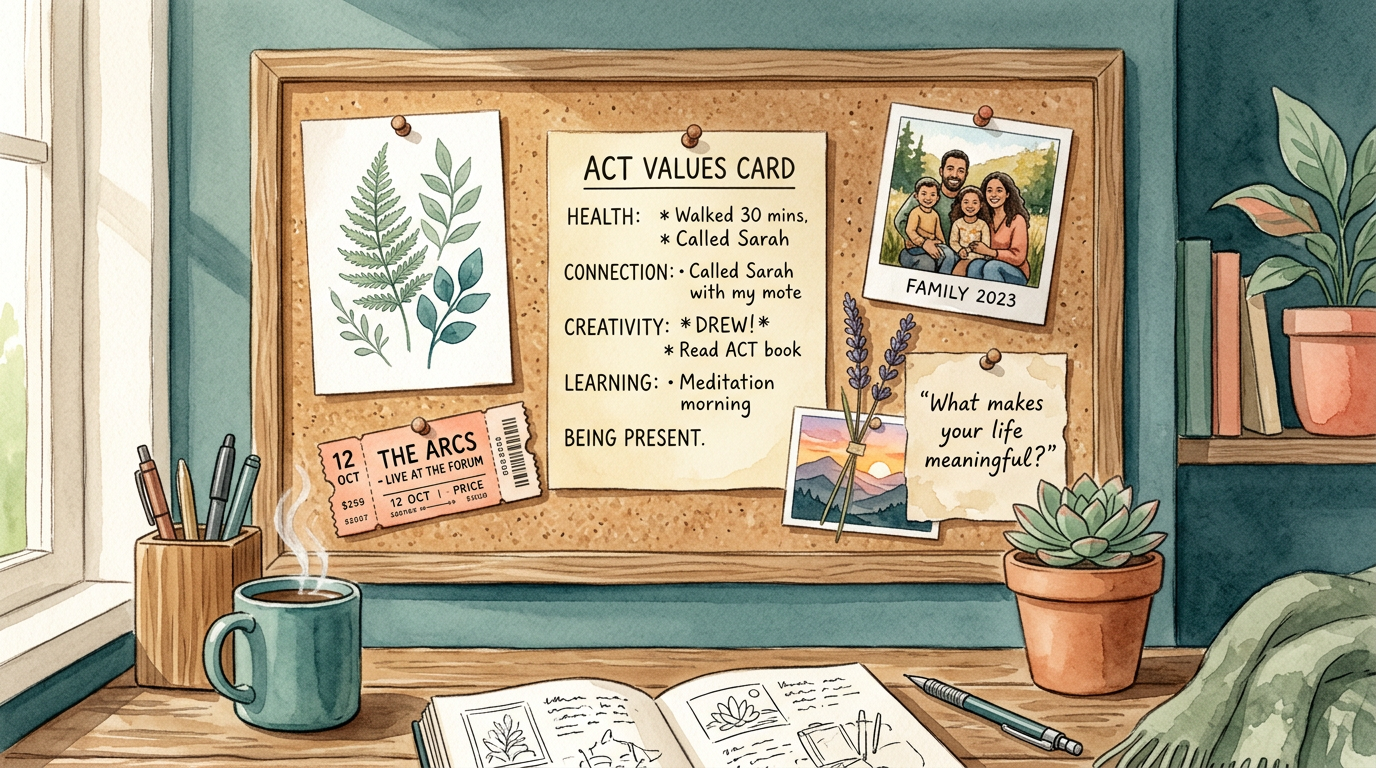
An ACT Values Card is a personal, tangible reminder of what truly matters to you, helping you make choices that align with your core principles. It's a single-page document that you create for yourself, outlining a few key values you want to focus on for a specific period, like a month. Alongside each value, you'll brainstorm and commit to specific, concrete actions that bring that value to life. It’s a core practice within Acceptance and Commitment Therapy (ACT), a type of mindfulness-based therapy that helps people relate to their difficult thoughts and feelings in a new way, freeing them up to build a rich and meaningful life.
The "why" is rooted in a fundamental distinction ACT makes between values and goals. Goals are finite destinations you can reach and check off a list (e.g., "run a marathon," "get a promotion"). Values, on the other hand, are directions; they are lifelong, ongoing qualities of action you want to embody (e.g., "being physically healthy," "being a dedicated professional"). You can never "finish" living a value. A values card helps you translate these broad, abstract directions into the concrete, everyday stuff of life.
Using a values card on a monthly basis serves a few key purposes:
- It creates focus. Instead of feeling overwhelmed by trying to be everything to everyone all at once, you can consciously choose to focus your energy on 2-3 values for the month.
- It encourages consistency. Building a meaningful life is a practice, not a project. A monthly check-in builds the habit of values-based living, allowing for course correction and fresh starts.
- It adapts to your life. Life changes. The demands of your career, the needs of your family, and your own personal growth mean that the value you need to focus on in May might be different from the one that needs your attention in October. A monthly practice keeps your compass calibrated to your current reality.
Identifying Your Core Values: The Foundation of Your Card
To identify your core values, you need to engage in some gentle self-reflection. The goal isn't to find the "right" answers, but to connect with what genuinely energizes and inspires you. You can start by considering moments of peak happiness, times of significant challenge, or what you'd want your legacy to be. Using prompts and lists of common values can help get the ball rolling.
Step 1: Brainstorming Across Life Domains
Values show up in all areas of our lives. It can be helpful to think about what's important to you within different categories. You don't need to have a value for every domain, but it's a great way to start brainstorming. Consider these common areas:
- Work & Career: What kind of colleague, leader, or employee do you want to be? (e.g., diligent, creative, supportive, ethical)
- Relationships: This can include family, friends, and romantic partners. How do you want to show up for the people you love? (e.g., loving, present, supportive, loyal)
- Personal Growth & Learning: What matters to you in terms of your own development? (e.g., curiosity, courage, wisdom)
- Health & Well-being: What's important in how you care for your body and mind? (e.g., vitality, balance, self-compassion)
- Community & Environment: How do you want to relate to the world around you? (e.g., contribution, kindness, sustainability)
- Spirituality: This can be religious or secular. What connects you to a sense of meaning or purpose larger than yourself? (e.g., awe, connection, peace)
- Leisure & Fun: How do you want to recharge and enjoy yourself? (e.g., playfulness, adventure, creativity)
Step 2: The "80th Birthday" Exercise ✨
A classic ACT exercise to clarify values is to imagine yourself at your own 80th birthday party (or a similar milestone). Imagine someone you care about stands up to give a speech about you and the life you've lived.
- What would you want them to say about you?
- What qualities would you hope they highlight?
- How would you want to be remembered as a parent, a friend, a colleague, and a person?
The words and themes that come up here—like "He was always so curious," "She was the most compassionate person I knew," or "They always stood up for what was right"—point directly to your deepest values.
Step 3: From Abstract Ideas to Concrete Values
Once you have some ideas, you can try to distill them into single words or short phrases. Below is a list to help you find the right language. Scan it and see what words resonate with you.
- Acceptance
- Adventure
- Authenticity
- Balance
- Beauty
- Compassion
- Connection
- Contribution
- Courage
- Creativity
- Curiosity
- Diligence
- Fairness
- Flexibility
- Freedom
- Friendliness
- Fun
- Generosity
- Gratitude
- Honesty
- Humor
- Justice
- Kindness
- Knowledge
- Love
- Mindfulness
- Order
- Patience
- Playfulness
- Security
- Self-Compassion
- Spirituality
- Stability
- Strength
- Trust
- Vitality
Remember to distinguish your chosen values from goals. A goal is a finish line; a value is the direction you're running.
| Feature | Value | Goal |
|---|---|---|
| Nature | A chosen direction, a continuous process | A desired outcome, a destination |
| Example | Being a loving and connected partner | Getting married or going on weekly dates |
| Timeline | Ongoing, lifelong | Can be completed or ticked off a list |
| Availability | You can live it in this very moment | It is achieved at some point in the future |
| Control | You fully control your value-based actions | Outcome is often influenced by externals |
| Feeling | Living the value can feel good, but the action is what counts | Achieving the goal often brings temporary satisfaction |
The Printable ACT Values Card Template
Here is a simple, effective template you can copy, paste into a document, and print for your monthly values practice. It’s designed to be straightforward, giving you space for what's most important: defining your values and committing to real-world actions.
# My ACT Values Card

**Month & Year:** _________________________

---

### Focus Value 1: _________________________

**Why this value matters to me right now:**
>

**Committed Actions to Embody This Value:**
*(What small, medium, and large actions can I take this month?)*

*   **Tiny (1-5 min):**
*   **Small (5-30 min):**
*   **Medium (30+ min):**

**Potential Obstacles (Internal & External):**
*(e.g., "I'm too tired," "I don't have time," critical thoughts, unexpected events)*
>

**My Mindful & Compassionate Response:**
*(How will I treat myself when I get off track? How will I gently return to my value?)*
>

---

### Focus Value 2: _________________________

**Why this value matters to me right now:**
>

**Committed Actions to Embody This Value:**

*   **Tiny (1-5 min):**
*   **Small (5-30 min):**
*   **Medium (30+ min):**

**Potential Obstacles (Internal & External):**
>

**My Mindful & Compassionate Response:** 💧
>

---

### Monthly Reflection

**What went well? What did I learn?**
>

**What will I carry forward into next month?**
>
A Filled-In Example: Bringing the Values Card to Life
Seeing a completed values card can make the process much clearer. This example focuses on the values of "Connection" and "Creativity" for a hypothetical person who has been feeling isolated and creatively stifled lately.
My ACT Values Card
Month & Year: October 2024
Focus Value 1: Connection
Why this value matters to me right now:
I've been feeling lonely and disconnected from friends lately. I value my friendships deeply and want to be a more present and engaged friend, even when I'm busy or feeling tired. It brings me joy and a sense of belonging.
Committed Actions to Embody This Value:
- Tiny (1-5 min): Send a "thinking of you" text to a friend each morning.
- Small (5-30 min): Call one family member or friend for a quick chat while walking the dog.
- Medium (30+ min): Schedule one coffee or lunch date with a local friend for this month.
Potential Obstacles (Internal & External):
Internal: The thought "I'm bothering them" or "I don't have the energy to talk." External: Busy schedules making it hard to connect.
My Mindful & Compassionate Response:
I will acknowledge the "I'm a bother" thought, thank my mind for trying to protect me, and send the text anyway. If I'm tired, I can send a shorter message. I will be flexible with scheduling and remember that the effort to connect is what matters. 💧
Focus Value 2: Creativity
Why this value matters to me right now:
My work is very analytical, and I miss having a creative outlet. I want to reconnect with my playful, artistic side for its own sake, without pressure for it to be "good." It helps me feel more whole and balanced.
Committed Actions to Embody This Value:
- Tiny (1-5 min): Doodle in a notebook for 5 minutes during my lunch break, no goal in mind.
- Small (5-30 min): Spend 20 minutes one evening playing the guitar, even just chords.
- Medium (30+ min): Visit the local art museum for an hour one Saturday afternoon.
Potential Obstacles (Internal & External):
Internal: The critical voice that says "You're not a real artist" or "This is a waste of time." External: Feeling too drained after work to do anything extra.
My Mindful & Compassionate Response:
I will treat my inner critic like a worried, unhelpful friend—notice its presence without arguing with it. I will remind myself that the goal is the process of being creative, not the product. If I'm tired, the 5-minute doodle is a perfect, achievable action.
This framework shows how to move from a big, important feeling ("I want more connection") to a tiny, concrete action ("Send one text"). This is the magic of committed action. 📊
     Value: [      CREATIVITY      ]
              |
              V
Committed Action Brainstorm: [ Write a book, learn piano, daily sketch, visit museum ]
              |
              V
 Obstacles: [ "No time," "Not good enough," "Too tired" ]
              |
              V
Mindful Response: [ Acknowledge the thought, thank my mind, redirect to the value ]
              |
              V
This Month's Small, Committed Action:
+-----------------------------------------+
|   [ Doodle for 5 minutes at lunch ]     |
+-----------------------------------------+
Customizing Your Card and Integrating It Into Your Life
A printable template is just a starting point. To make this practice truly your own, you should feel free to customize your card and develop a personal rhythm for using it. The goal is for it to be a helpful tool, not a rigid chore.
"Your values card isn't a report card for you to be graded on. It's a compass, lovingly crafted by you, for you, to help you navigate the beautiful, messy territory of your own life." 🕊️
Making It Your Own 🌿
Here are a few ideas for personalizing your values card practice:
- Get Creative: Use colored pens, markers, stickers, or even draw little icons next to your values. Making the card visually appealing can make you more excited to use it.
- Focus Intensely: Instead of two or three values, you might dedicate a whole month to exploring just one value in depth, especially if it's new or particularly challenging for you.
- Reframe the Language: If "Committed Actions" feels too high-pressure, try calling them "Value Experiments" or "Mindful Moments." The goal is curiosity and engagement, not perfect performance.
- Go Digital: If you're not a pen-and-paper person, re-create this template in a digital notes app (like Notion, Evernote, or Apple Notes), a private blog, or even a dedicated spreadsheet.
Making It a Habit 🧘
A beautiful values card is only effective if you use it. Here’s how to integrate it into your daily and weekly rhythm:
- Keep It Visible: Place your printed card somewhere you’ll see it every day. Your bathroom mirror, your bedside table, your desk, or pinned to the fridge are all great spots.
- Schedule Check-ins: Put a recurring 5-minute appointment on your calendar every Sunday evening or Monday morning to review your card. Ask yourself: "How did I do at moving toward these values last week? What's one tiny step I can take this week?"
- Use It as a Decision Filter: When facing a decision, whether big or small, glance at your card and ask, "Which choice moves me toward the person I want to be and the life I want to live?"
- Share Your Journey: While your values card is personal, you can share the process with a trusted friend, partner, or therapist. Saying your intentions out loud—"I'm focusing on being more courageous this month"—can create gentle accountability.
Frequently Asked Questions (FAQ)
What if I can't think of any values?
This is very common! Don't pressure yourself. Start by looking at a comprehensive list of values online (search for "ACT values list"). Read through it and simply notice which words give you a little spark of energy or recognition. Another great technique is to think of someone you admire, living or dead, real or fictional. What qualities do they embody that you respect? Those are likely clues to your own values. Start with one or two that feel "good enough for now." They can always change. 💡
What's the difference between a value and a feeling?
This is a key distinction. A feeling is a transient internal experience, like happiness, sadness, anxiety, or excitement. You can't directly control when they show up. A value is a chosen quality of action that you can control. For example, "happiness" is a feeling, whereas "gratitude" or "playfulness" are values you can choose to act on. The goal of ACT isn't to feel good all the time, but to live a value-driven life, bringing all your feelings along for the ride. You can act with kindness (a value) even when you are feeling angry (a feeling).
I keep failing at my committed actions. What should I do?
Welcome to being human! A values practice is not about perfection; it’s about direction and re-direction. First, offer yourself some self-compassion. Acknowledge that it's hard and that you got off track, and then gently and kindly guide yourself back. Second, look at your actions. Are they too big? If your committed action is "exercise for 60 minutes" and you never do it, it's not a helpful action. Break it down until it's "ridiculously easy." Could you do 5 minutes of stretching? Or even just put on your workout clothes? Lower the bar until you can't fail.
When to See a Professional
This values card template is a tool for self-discovery and personal growth. It can be a wonderful supplement to a healthy lifestyle and even therapy. However, it is not a substitute for professional mental health care. If you are struggling with persistent feelings of emptiness, depression, overwhelming anxiety, or feel deeply stuck in unhelpful patterns, seeking support from a licensed therapist or counselor is a courageous act of self-care. A professional can help you navigate these challenges with evidence-based strategies, including a deeper application of ACT principles, in a safe and supportive environment.
At Araam, our guided journeys and mindfulness exercises can support your values exploration. Our AI companion is here 24/7 to help you process your thoughts and feelings as you embark on this rewarding practice.