Highly Sensitive Person (HSP): The Science and a Life Plan
Have you ever been told you’re “too sensitive” or that you need to “grow a thicker skin”? Do you feel a pang of deep empathy for a character in a movie, get easily overwhelmed by a crowded supermarket
Have you ever been told you’re “too sensitive” or that you need to “grow a thicker skin”? Do you feel a pang of deep empathy for a character in a movie, get easily overwhelmed by a crowded supermarket, or notice the subtle shift in a friend's mood before anyone else does? If so, you’re not alone, and you’re not broken. You might be what researchers call a Highly Sensitive Person (HSP), a personality trait that affects an estimated one in five people. This isn't a disorder or a flaw; it's a finely-tuned nervous system that processes the world with extraordinary depth and awareness. It’s time to stop seeing this trait as a burden and start understanding it for what it is: a powerful, innate part of who you are, with its own unique set of strengths and needs. 🌱
What Exactly Is a Highly Sensitive Person (HSP)?
A Highly Sensitive Person (HSP) is someone with a neutral, innate personality trait known as Sensory Processing Sensitivity (SPS). This means their brain and nervous system are wired to process physical, social, and emotional stimuli more deeply and thoroughly than most. Coined by psychologist and researcher Dr. Elaine N. Aron in the 1990s, this trait is not a disorder, a choice, or a result of life experience, but rather a biological difference.
About 15-20% of the population are thought to be HSPs. This trait is not just a human phenomenon; it has been observed in over 100 different species, from fruit flies to fish to primates. From an evolutionary perspective, the sensitive members of a group serve a vital role—they are the "royal advisors," the ones who notice subtle dangers, opportunities, or social cues that others miss, benefiting the entire community.
Being an HSP means you experience the world with a heightened level of intensity. The vibrant color of a sunset might fill you with awe, while a scratchy sweater tag might feel like a genuine torment. The key is understanding that your brain is simply taking in more information and processing it on a much deeper level.
Unpacking the Science: Aron's DOES Model
To make the trait easier to understand, Dr. Aron developed the acronym DOES to summarize the four core aspects of high sensitivity. If you consistently relate to all four of these pillars, you likely fall on the HSP spectrum.
D is for Depth of Processing
Depth of processing is the cornerstone of the HSP trait. Your brain doesn't just skim the surface of information; it dives deep. When making a decision, you might find yourself weighing every possible outcome, considering all the nuances, and reflecting on past experiences. This can make you a fantastic strategist, a conscientious employee, and a thoughtful friend. The flip side? It can also lead to decision fatigue or a feeling of being "stuck" in your own head because you’re processing so much data.
O is for Overstimulation (or Overarousal)
Because you are processing everything so deeply, it’s only natural that you get overwhelmed more easily. The same environment that feels pleasantly bustling to a non-HSP can feel like a chaotic assault on the senses to you. Think of your nervous system as a high-fidelity microphone—it picks up everything. Crowded malls, loud concerts, open-plan offices, or even a day packed with too many social engagements can leave you feeling frazzled, exhausted, and in desperate need of quiet and solitude to "reboot." 💧
E is for Emotional Responsivity & Empathy
HSPs experience emotions—both positive and negative—more intensely. You might cry from joy over a beautiful piece of music or feel profound sadness when witnessing injustice. This emotional richness is deeply connected to empathy. HSPs often have a powerful ability to feel what others are feeling, as if the boundary between themselves and others is more porous. Your mirror neurons, the brain cells linked to empathy, are often highly active. While this makes you an incredibly compassionate and supportive friend or partner, it can also lead to emotional exhaustion if you absorb the emotions of everyone around you.
S is for Sensing the Subtle
This is the "superpower" many HSPs recognize in themselves. You notice the little things. The faint scent of rain before a storm, the tiny, almost imperceptible shift in someone's tone of voice, the new picture on a colleague's desk, or the way the light hits a room differently in the afternoon. This sensitivity to subtleties makes you highly intuitive and often very creative. You're attuned to the fine print of life that most people simply filter out. ✨
[[IMAGE:fig2|An infographic showing a person's "environmental blueprint" for thriving as an HSP.|A clean, empowering infographic with a person at the center. Lines connect them to icons representing key life areas. One icon is a cozy home with a 'quiet corner' symbol. Another is a pair of noise-canceling headphones. A third is a calendar with 'unplugged' time blocked off. A fourth shows a small group of three people, representing a curated social circle. A final icon is a leaf, representing time in nature. The style is modern, friendly, and practical.]]
Is It HSP, or Something Else?
It's common for high sensitivity to be confused with other traits or conditions. While there can be overlap, the underlying mechanics are very different. HSP is an innate trait, not a mental health disorder. Understanding these distinctions is a key step in self-awareness.
| Trait / Condition | Key Characteristic | How It Differs from HSP |
|---|---|---|
| Introversion | Prefers low-stimulation environments to recharge energy. | About 70% of HSPs are introverts, but 30% are extroverts. An extroverted HSP craves social connection but can get overwhelmed by it quickly, creating a unique push-pull dynamic. |
| Social Anxiety | An intense fear of being judged or negatively evaluated in social situations. | An HSP may avoid social events because they are overstimulating (too much noise, light, emotion), not necessarily because they fear judgment. HSP is a trait; social anxiety is a fear-based condition. |
| ADHD | Difficulty with attention regulation, impulsivity, and executive function. | While both HSPs and individuals with ADHD can be sensitive to stimuli, ADHD is primarily a challenge of focus. An HSP is overstimulated by too much information, while someone with ADHD may be understimulated and seeking more input to focus. |
| Autism Spectrum | Differences in social communication and interaction, and restricted, repetitive patterns of behavior. | While sensory sensitivities can be a feature of autism, HSP is primarily about deep processing and empathy. The core social and communication differences characteristic of autism are not inherent to the HSP trait. |
The HSP Self-Assessment: Signs and Indicators
This is not a diagnostic tool, but a list for self-reflection. If you find yourself nodding enthusiastically to many of these, you may want to explore the HSP trait further.
-
Environmental Sensitivity:
- Are you easily startled by sudden noises, like a siren or someone coming up behind you?
- Do you find yourself deeply affected by violent movies or TV shows?
- Do you have a low pain threshold?
- Are you sensitive to caffeine or the effects of medication?
-
Emotional & Social Experience:
- Do you feel the need to withdraw during busy days, seeking a dark, quiet room to de-stress?
- Do you find yourself avoiding situations that you know will be overwhelming?
- Do you make it a high priority to arrange your life to avoid upsetting or overstimulating situations?
- Are you deeply moved by the arts, music, or nature? 🕊️
-
Internal Processing:
- Do you have a rich, complex inner life?
- Were you described as "shy" or "sensitive" as a child?
- Do you notice and feel bothered when people are uncomfortable in a physical environment (e.g., the lighting is too harsh, the seating is awkward)?
- Do you find yourself needing more time than others to make decisions?
Creating Your Personal Environmental Blueprint
Thriving as an HSP isn't about changing who you are; it's about changing your environment to honor your temperament. Think of yourself as a delicate orchid—you can't just plant it anywhere and expect it to bloom. It needs the right soil, light, and humidity. Here's how to create your own "greenhouse."
Your Physical Space: The Sanctuary 🌿
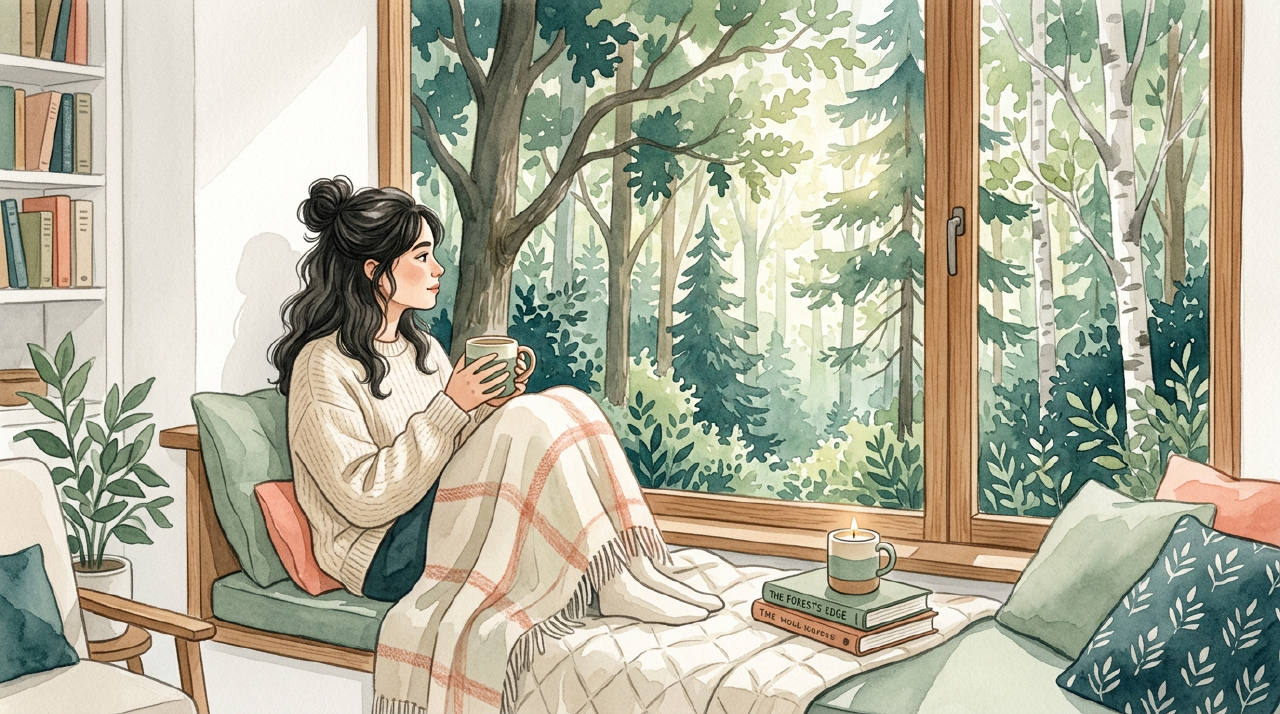
Your home should be your sanctuary, the place you go to recharge, not a source of further stimulation.
- Declutter: Visual clutter is mental clutter. Keep surfaces clear and organized.
- Control the Light: Use dimmer switches, blackout curtains, and warm, soft lighting (like lamps instead of harsh overheads).
- Manage Sound: Invest in noise-canceling headphones. Use a white noise machine or calming playlists. Place rugs and textiles to absorb sound.
- Create a Retreat: Designate one corner, chair, or room as your "do not disturb" zone for quiet reflection, meditation, or reading. 🧘
Your Social Circle: The Support System
Your social energy is a precious resource. Spend it wisely.
- Quality over Quantity: Focus on nurturing a few deep, meaningful relationships rather than a wide circle of acquaintances.
- Seek the Like-Minded: Connect with other sensitive, empathetic people who understand your need for both connection and downtime.
- The One-on-One Advantage: Opt for coffee with one friend over a loud group dinner. HSPs often shine in deeper, more intimate conversations.
Your Schedule: The Rhythm of Rest and Action
A common mistake for HSPs is trying to keep up with the fast-paced, "always on" culture. This is a recipe for burnout.
- Bookend Your Days: Start and end your day with quiet time. This could be 15 minutes of journaling, meditation, or simply sipping tea without your phone.
- Build in Buffers: Don't schedule appointments or meetings back-to-back. Give yourself transition time to process one experience before moving on to the next.
- Plan for Downtime: Literally schedule "do nothing" time into your calendar. Protect this time as fiercely as you would a doctor's appointment. It is just as crucial for your health.
Here's a way to visualize the difference in stimulation needs between HSPs and non-HSPs:
Performance/Well-being
  ^
  |                     /----\  <-- Non-HSP
  |                    /      \
  |      Optimal -->  /        \
  |      Window      /          \
  |   /-----\       /            \
  |  /       \ <-- HSP          |
  | /         \                 |
  |/           \                | Overarousal/Distress
  +--------------------------------------------------->
   Low           Moderate           High
                 Level of Stimulation
📊 The chart shows that HSPs reach their optimal performance and well-being with less stimulation and can become overstimulated more quickly. The goal is to live in that sweet spot.
Thriving as an HSP: A Practical Life Plan
Beyond your environment, a few key mindset shifts and practices can transform your experience of sensitivity from a challenge to a gift.
Being sensitive is not a weakness. It means you are exquisitely aware of the world, capable of profound empathy, deep connection, and breathtaking creativity. Your sensitivity is the doorway to your greatest gifts.
Embrace Downtime (Without Guilt)
Rest is not lazy; it is productive. For an HSP, downtime is not a luxury; it is a biological necessity. It's when your brain sorts, files, and makes sense of all the data it has collected. Reframe rest as "processing time" and give yourself permission to take it without feeling guilty.
Set Healthy Boundaries
Boundaries are the loving way you tell the world how to treat you. For HSPs, this is especially critical for managing energy.
- Learn to say "no": "No" is a complete sentence. You don't have to attend every party or take on every project.
- Set time limits: "I can stay for an hour, but then I need to head home."
- Protect your emotional energy: It's okay to limit your exposure to people or news that consistently drain you.
Reframe Your Sensitivity as a Strength 💡
For every challenge of being an HSP, there is a corresponding strength.
- Overstimulation leads to a need for a rich, curated inner life.
- Deep processing makes you conscientious, creative, and insightful.
- High empathy makes you an exceptional friend, leader, and caregiver.
- Noticing subtleties makes you intuitive and appreciative of beauty.
Own these strengths. Celebrate them. Your sensitivity is not something to be overcome; it's something to be honored and leveraged.
Frequently Asked Questions
Q: Is being a Highly Sensitive Person a medical diagnosis? A: No. High sensitivity, or Sensory Processing Sensitivity (SPS), is a neutral personality trait, not a medical condition or mental disorder listed in the DSM-5. It's a fundamental aspect of how some people are wired, similar to being introverted or extroverted.
Q: Can I "cure" or get rid of my high sensitivity? A: No, and you wouldn't want to! Since it's an innate, biological trait, it can't be "cured." It would be like trying to cure your eye color. The goal is not to eliminate your sensitivity but to learn how to manage the challenges (like overstimulation) and harness the many strengths that come with it.
Q: Are all Highly Sensitive People introverts? A: Not at all. While research shows that approximately 70% of HSPs identify as introverts, that leaves a significant 30% who are extroverts. These "Highly Sensitive Extroverts" are in a unique position: they crave social interaction but are also easily overwhelmed by it. They need to find a balance that honors both their need for connection and their need for restorative quiet.
When to See a Professional
While being an HSP is a normal, healthy trait, the challenges that come with it—such as chronic overwhelm, anxiety, or feeling misunderstood—can take a toll on your mental health. If you feel that your sensitivity is contributing to significant distress, persistent anxiety, depression, or difficulty functioning in your daily life, it may be helpful to speak with a therapist or counselor. A professional who is knowledgeable about the HSP trait can provide you with personalized strategies and support to help you navigate the world more comfortably and confidently.
Remember, understanding yourself is the first step toward living a life that feels authentic and fulfilling. The Araam app offers guided meditations for managing overwhelm, a journaling feature to explore your rich inner world, and tools to help you build a life that honors your unique nervous system. You have a rare and beautiful way of experiencing the world—we're here to help you embrace it.