Panic Attack First Aid: A 90-Second Toolkit Grounded in the Vagus Nerve
It arrives without warning. A sudden tidal wave of fear that crashes over you, leaving you gasping for air. Your heart hammers against your ribs like a trapped bird, your palms grow slick with sweat,
It arrives without warning. A sudden tidal wave of fear that crashes over you, leaving you gasping for air. Your heart hammers against your ribs like a trapped bird, your palms grow slick with sweat, and the world begins to feel unreal, as if you’re watching your own life through a distorted lens. A single, terrifying thought echoes in the chaos: I’m losing control. This is the visceral, isolating reality of a panic attack. But what if you had a toolkit—a sequence of simple, science-backed actions you could deploy in the moment—to find your footing in under 90 seconds? This isn’t about "toughing it out" or ignoring the fear. It’s about understanding the biology of panic and using your own body’s wiring to gently and effectively guide yourself back to safety. 🕊️
Before we dive into the step-by-step guide, here’s a quick overview of the 90-second first-aid plan you’re about to learn.
| Step | Action | Estimated Time | Primary Goal |
|---|---|---|---|
| 1 | Name It to Tame It | 5 seconds | Reduce cognitive confusion and fear. |
| 2 | The Cold Water Plunge | 15 seconds | Trigger a physiological "reset" switch. |
| 3 | Breathe Your Way to Calm | 15 seconds | Rapidly balance CO2/O2 and calm the heart. |
| 4 | Anchor in the Present | 45 seconds | Shift focus from internal chaos to external reality. |
| 5 | Offer a Kind Word | 10 seconds | Introduce self-compassion to break the fear cycle. |
| 6 | Prepare Your Pocket Guide | 10 mins (Prep) | Have a physical or digital prompt ready for next time. |
What is a Panic Attack and Why Does It Feel So Overwhelming?
A panic attack is an intense, abrupt surge of fear or discomfort that peaks within minutes. It’s not just "feeling very anxious"; it's a full-body physiological event. To understand what’s happening, we need to look at our nervous system. Think of it as having a gas pedal and a brake pedal.
- The "Gas Pedal" (Sympathetic Nervous System): This is your ancient, hard-wired survival system. When it perceives a threat—whether it’s a saber-toothed tiger or a catastrophic thought—it floors the gas pedal, triggering the "fight-or-flight" response. It floods your body with adrenaline and cortisol, preparing you to face danger.
- The "Brake Pedal" (Parasympathetic Nervous System): This system does the opposite. It’s the "rest-and-digest" network that slows your heart rate, deepens your breathing, and tells your body, "The threat is over. You are safe."
A panic attack is essentially your sympathetic nervous system hijacking your body, slamming on the gas pedal even when there's no external danger. The symptoms are the direct result of this adrenaline surge:
- Pounding heart or palpitations
- Sweating, trembling, or shaking
- Shortness of breath or a feeling of being smothered
- A choking sensation
- Chest pain or discomfort
- Nausea or stomach distress
- Feeling dizzy, lightheaded, or faint
- Chills or heat sensations
- Numbness or tingling (paresthesia)
- Derealization (feelings of unreality) or depersonalization (being detached from oneself)
- Fear of losing control or "going crazy"
- Fear of dying
The sheer intensity of these physical sensations can create a terrifying feedback loop. You feel your heart race, which makes you fear you're having a heart attack, which releases more adrenaline, which makes your heart race faster. Our 90-second toolkit is designed to cut this loop by intentionally activating the "brake pedal."
Meet Your Body's Built-In Emergency Brake: The Vagus Nerve
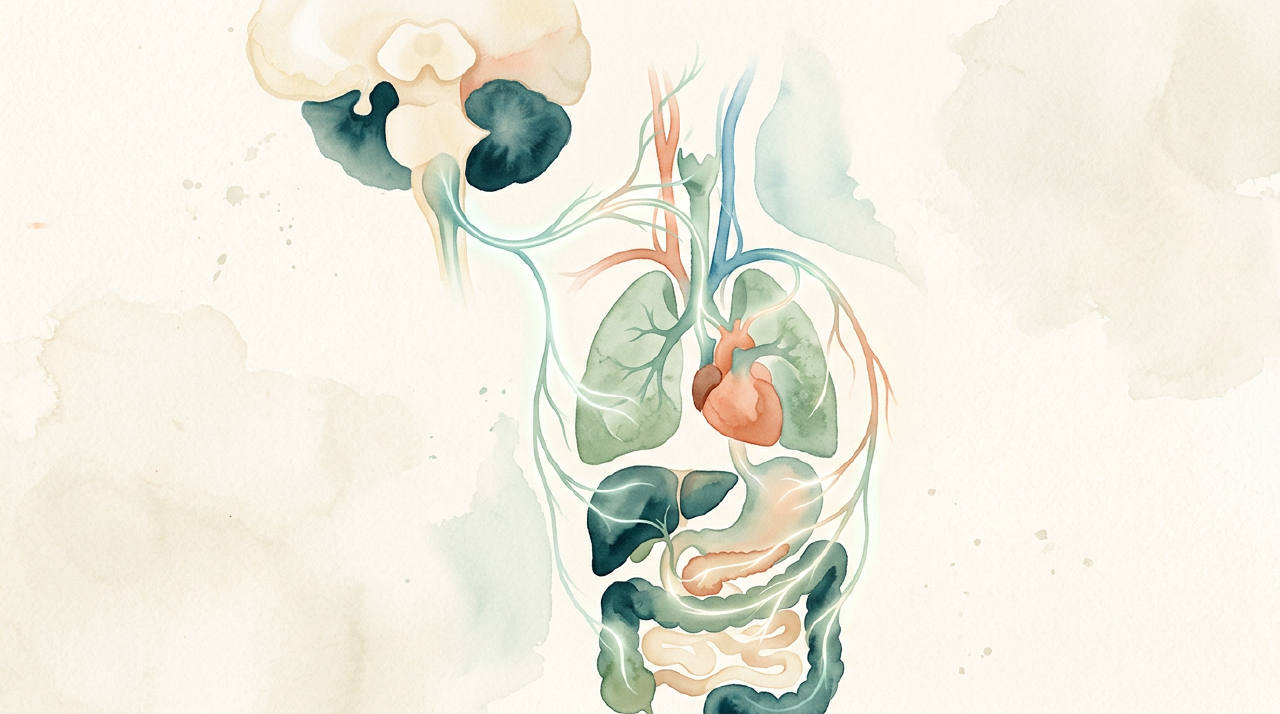
The hero of our story is the vagus nerve. It’s the longest cranial nerve in your body, a wandering superhighway of information connecting your brain to your heart, lungs, and digestive system. It is the primary commander of your parasympathetic ("brake pedal") nervous system. 🌱 When the vagus nerve is stimulated, it releases a neurotransmitter called acetylcholine, which acts like a natural tranquilizer, lowering your heart rate and blood pressure and signaling to your brain that it’s time to relax.
The techniques in this guide are not random distractions; they are targeted methods for "hacking" into your own physiology and manually stimulating the vagus nerve to apply the brakes during a panic attack.
Sympathetic vs. Parasympathetic Response: A Quick Comparison
Understanding the two sides of your autonomic nervous system can be incredibly empowering. It reframes a panic attack from a personal failing to a biological process that you can influence.
| Feature | Sympathetic Nervous System (The "Gas Pedal") | Parasympathetic Nervous System (The "Brake Pedal") |
|---|---|---|
| Primary Role | Fight, Flight, or Freeze | Rest and Digest |
| Heart Rate | Increases | Decreases |
| Breathing | Fast and Shallow | Slow and Deep |
| Pupils | Dilate | Constrict |
| Digestion | Slows or Stops | Activates |
| Key Signal | Adrenaline Rush | Vagal Nerve Stimulation |

Your 90-Second Panic Attack First Aid Kit: A Step-by-Step Guide
The moment you feel the first wave of panic, start the clock. The goal is not to fight the feelings but to move through them with intention. This sequence is designed to be a progressive cascade, where each step builds on the last to gently guide your nervous system back into balance.
Step 1: Name It to Tame It (0-5 seconds)
- Estimated time: 5 seconds
- Tools: Your thoughts
- Key tip: Use a simple, factual statement. Avoid judgmental language like "Oh no, not again!" or "Why is this happening?"
The first step is cognitive. In the midst of rising panic, your brain is scrambling for an explanation. It might latch onto terrifying ideas: "I'm having a heart attack," "I'm suffocating," or "I'm going crazy." Your job is to provide it with the correct, non-catastrophic label.
Simply say to yourself, either out loud or in your head: "This is a panic attack. It is uncomfortable, but it is not dangerous. It will pass."
This act of labeling, a technique studied in neuroscience, does two things. First, it creates a sliver of distance between you and the experience. You are not the panic; you are the one observing the panic. Second, it shifts activity from the reactive, emotional amygdala to the more logical prefrontal cortex, giving you back a tiny bit of executive control. ✨
Step 2: The Cold Water Plunge (5-20 seconds)
- Estimated time: 15 seconds
- Tools: Cold water, an ice pack, a cold can of soda, or even a cool windowpane.
- Key tip: Focus the cold stimulus on the area around your nose and cheeks for the strongest effect.
Now for a powerful physiological reset. You need to trigger something called the mammalian dive reflex. This is an ancient reflex present in all air-breathing vertebrates. When our face is submerged in cold water, our body automatically thinks we're diving underwater and initiates a series of changes to conserve oxygen, the most important of which is a rapid slowing of the heart rate (bradycardia).
You don't need to submerge your whole head. Simply:
- Go to a sink and splash your face with the coldest water you can tolerate for 15-30 seconds.
- If you can't get to a sink, press an ice pack or a bag of frozen veggies against your face and hold it there.
- Even holding a cold drink can to your cheeks and neck can help.
This sends a powerful signal via the vagus nerve directly to your heart's pacemaker, telling it to slow way down. It's one of the fastest ways to interrupt the racing heart symptom of a panic attack. 💧
Step 3: Breathe Your Way to Calm (20-35 seconds)
- Estimated time: 15 seconds (for 2-3 cycles)
- Tools: Your lungs
- Key tip: The key is the double inhale, followed by a very long, slow exhale. Don't force it; be gentle.
During panic, you often hyperventilate—taking short, shallow breaths that blow off too much carbon dioxide, leading to dizziness and tingling. The "physiological sigh" is the fastest known way to correct this and calm the nervous system. Research from Stanford University has shown this breathing pattern is something we do involuntarily to soothe ourselves (like when we're about to fall asleep or after crying).
Here's how to do it consciously:
- Take a deep breath in through your nose.
- Without fully exhaling, take another short, sharp inhale to completely fill your lungs.
- Exhale very slowly and completely through your mouth, for as long as you can.
Do this two or three times. The double inhale helps to reinflate any tiny air sacs (alveoli) in your lungs that may have collapsed during shallow breathing, allowing for a more efficient gas exchange. The long exhale activates the vagus nerve, further slowing your heart rate. 🧘
"The fastest way to break the feedback loop of panic is not to fight the thoughts, but to anchor the body in the physical reality of the present moment. Your senses are the gateway."
Step 4: Anchor in the Present Moment (35-80 seconds)
- Estimated time: 45 seconds
- Tools: Your five senses
- Key tip: Verbally describe what you are sensing to yourself, as if you're a narrator. "I see the blue pen on my desk. I see the wood grain. I see the light from the window."
Now that you've slowed your physiology, it's time to ground your mind. Panic thrives in future-oriented, catastrophic thoughts. The 5-4-3-2-1 Grounding Technique yanks your attention out of that internal storm and anchors it in the neutral reality of your immediate surroundings.
Go through your senses one by one:
- 5 things you can SEE: Look around and name five things. Notice their color, shape, and texture. (e.g., a green plant, a scuff on the floor, the light switch, a crack in the ceiling, the pattern on a rug).
- 4 things you can FEEL: Bring your attention to the physical sensations on your body. (e.g., the fabric of your shirt on your shoulders, the floor under your feet, the cool air on your skin, the weight of your phone in your hand).
- 3 things you can HEAR: Listen closely and identify three sounds. (e.g., the hum of a computer, traffic outside, your own breathing).
- 2 things you can SMELL: Try to identify two distinct smells. (e.g., the scent of coffee, the soap on your hands, the dusty smell of a book).
- 1 thing you can TASTE: Focus on one thing you can taste. (e.g., the lingering taste of toothpaste, a sip of water, or simply the natural taste inside your mouth).
This exercise is incredibly effective because it's impossible for your brain to focus on your five senses and your panicked thoughts at the same time. You are deliberately redirecting your brain's resources.
Step 5: Offer Yourself a Kind Word (80-90 seconds)
- Estimated time: 10 seconds
- Tools: Your inner voice
- Key tip: Have one or two pre-prepared phrases that feel genuine to you.
You've regulated your body and grounded your mind. The final step is to introduce a dose of self-compassion. The panic cycle is often worsened by a layer of self-criticism or shame. Counter this with a simple, reassuring truth.
As your heart rate settles and your breathing deepens, say to yourself:
- "I am safe."
- "This feeling is passing."
- "I handled that well."
- "It's okay. I'm okay."
This final step validates your experience and reinforces the message of safety to your nervous system, helping to prevent the "aftershocks" of anxiety that can follow a panic attack. 🌿
Step 6: Create Your Pocket Guide (A Proactive Step)
- Estimated time: 10 minutes to prepare
- Tools: An index card and pen, or a notes app on your phone
- Key tip: Use large, clear lettering. Don't crowd the card with information.
During a panic attack, your ability to recall information plummets. It's wise to create a physical or digital "emergency card" to guide you when you need it most.
What to include on your card:
- Title: Panic Attack First Aid
- Fact: "This is a panic attack. It is a burst of adrenaline. It is not dangerous and will pass."
- Step 1: Splash face with COLD water.
- Step 2: Physiological Sigh (2 deep inhales, 1 long exhale). Repeat 3x.
- Step 3: 5-4-3-2-1 Grounding. (Just list the words: SEE, FEEL, HEAR, SMELL, TASTE).
- Reassurance: "You are safe. This will be over in a few minutes."
Keep this card in your wallet, bag, or as a locked note on your phone's home screen. Just knowing it's there can reduce anticipatory anxiety about having another attack.
Here is a simple visualization of your 90-second response:
+---------------------------------------------------------------------------------------+
| 90-Second Panic Attack Response Timeline                                              |
+---------------------------------------------------------------------------------------+
| 0-5s    | 5-20s            | 20-35s            | 35-80s              | 80-90s          |
| [LABEL] | [COLD RESET]     | [PHYSIO. SIGH]    | [5-4-3-2-1 GROUND]  | [SELF-TALK]     |
| "This is| Face in cold     | 2-3 cycles of     | Notice 5 things     | "I am safe."    |
| a panic | water.           | double inhales,   | you see, 4 you feel,| "This will pass."|
| attack."|                  | long exhales.     | 3 you hear, etc.    |                 |
+---------+------------------+-------------------+---------------------+-----------------+
📊
Frequently Asked Questions (FAQ)
What if I'm in public and can't use cold water?
This is a great question. The goal is a sudden temperature change on the face or upper body. If a public restroom isn't an option, try pressing a cold can or bottle of soda against your cheeks and neck. In a pinch, even stepping outside into cold air or holding your wrists under cold running water can provide a similar, though slightly less intense, vagal stimulation. The key is to have a plan B.
Can these techniques prevent a panic attack from starting?
Yes and no. Once a full-blown attack is triggered, these tools are for management and de-escalation. However, if you become skilled at noticing the very early warning signs of rising anxiety (e.g., a slight quickening of your heart, shallow breathing, racing thoughts), you can deploy a physiological sigh or a brief grounding exercise before the adrenaline cascade takes full hold. This can sometimes short-circuit the process and prevent the panic from peaking. 💡
I tried this and it didn't work perfectly. What did I do wrong?
You did nothing wrong! It's crucial to approach this toolkit with a mindset of practice, not perfection. The first few times you try this in a state of high alert, it will feel clumsy and might not work completely. That's okay. The goal isn't to instantly erase the panic but to lower its intensity from a 10/10 to maybe a 7/10 or 6/10. With repetition, your brain and body will learn this new response pattern, and it will become more effective and automatic over time.
How is a panic attack different from an anxiety attack?
This is a common point of confusion. "Anxiety attack" is not a clinical term found in the DSM-5 (the manual clinicians use), but it's widely used to describe a period of intense anxiety. Generally, a panic attack is marked by its abrupt onset, a peak of intensity within 10 minutes, and a powerful sense of terror or impending doom accompanied by strong physical symptoms. An anxiety attack often builds more gradually, can last longer, and is typically tied to a specific worry or stressor, with the primary feeling being worry rather than terror. The toolkit here is specifically designed for the acute, sudden nature of a panic attack.
When to See a Professional
This 90-second toolkit is a powerful form of emotional first aid. It is designed to help you manage the acute symptoms of a panic attack in the moment. However, it is not a substitute for professional mental health care.
Please consider speaking with a doctor or a licensed mental health professional if:
- Your panic attacks are happening frequently.
- You find yourself constantly worried about having another attack.
- You are beginning to avoid places or situations for fear of triggering a panic attack (a condition known as agoraphobia).
- Your anxiety is significantly impacting your daily life, work, or relationships.
A therapist can help you explore the root causes of your anxiety and provide evidence-based treatments like Cognitive Behavioral Therapy (CBT), which is highly effective for panic disorder.
Remember, learning to navigate panic is a journey. Be patient and compassionate with yourself.
If you’re looking for ongoing support in managing anxiety, building resilience, and understanding your mental health on a deeper level, Araam is here for you. Explore our library of guided meditations, use our journaling tools to track your progress, and connect with our AI companion anytime you need a listening ear. You don’t have to go through this alone.