
Why Araam Is Built Around Your Mental Health Data Privacy
In the quiet moments of your day, you open an app and begin to write. You pour out your anxieties, your hopes, your unfiltered thoughts—the kind of raw, honest reflections you might not even say aloud
In the quiet moments of your day, you open an app and begin to write. You pour out your anxieties, your hopes, your unfiltered thoughts—the kind of raw, honest reflections you might not even say aloud. It feels like a release, a private conversation with yourself. But as you hit "save," a nagging question can sometimes surface: where does this go? In a digital world where our data is often the currency, who else might be listening to our most private thoughts? It's a question that cuts to the very core of trust, and for anyone using technology to support their mental well-being, it's one of the most important questions to ask.
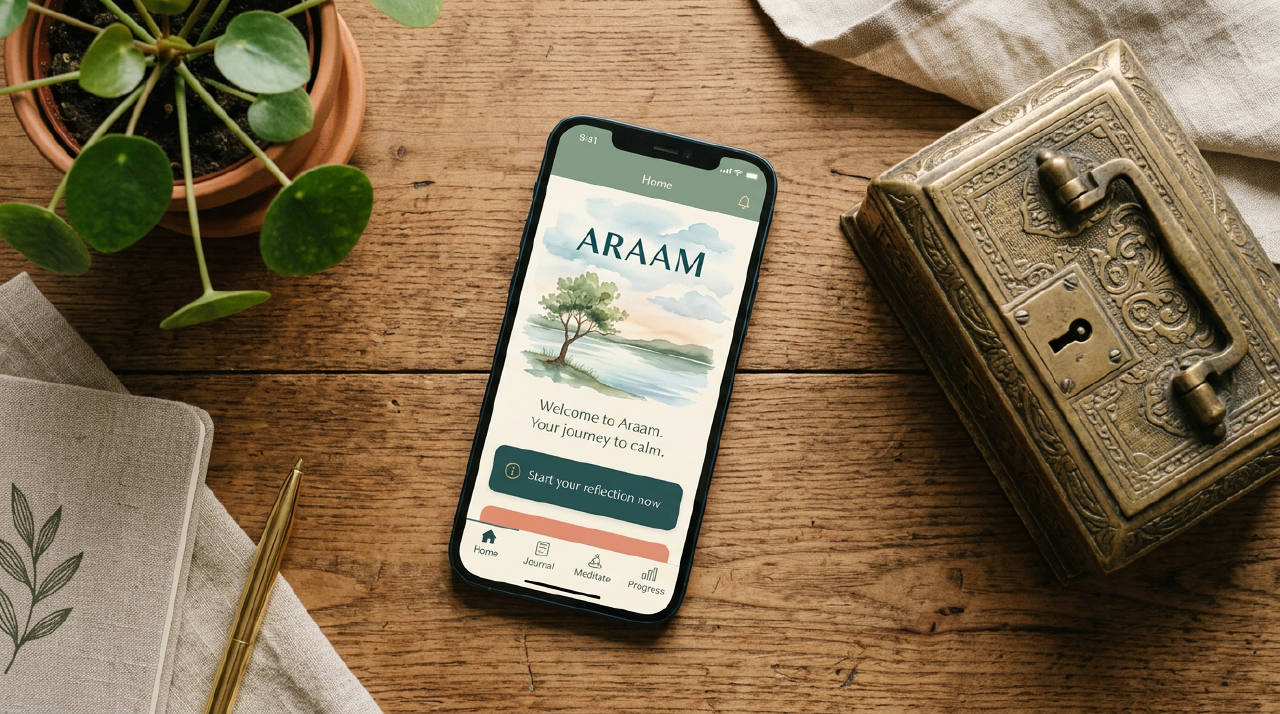
Araam's Privacy-First Philosophy: Our Verdict
For those seeking a digital journal and mental wellness companion, the primary concern is often safety—not just emotional safety, but data security. Our in-depth review finds that Araam is an exceptional tool meticulously engineered around the principle of user privacy, making it a top-tier choice for the security-conscious individual. Unlike many apps in the wellness space that operate on data-centric business models, Araam is built on a foundation of local-first storage and end-to-end encryption. This isn't just a feature; it's the entire philosophy. It means your deepest reflections, mood logs, and personal notes remain exactly that: personal. The app successfully marries a serene user experience with a fortress-like security architecture, providing a genuine sanctuary for your thoughts without the background worry of data mining or surveillance. It’s a premium product, but the price buys you peace of mind, which, in the realm of mental health, is invaluable.
Araam In-Depth Review: Scoring Privacy and Features
To understand Araam's value, we need to look at it holistically. How does its commitment to privacy affect its usability and feature set? We've scored it across four key categories to give you a clear picture of what it offers.
| Category | Score (out of 5) | Rationale |
|---|---|---|
| Design & User Experience | 🌱🌱🌱🌱🌱 (5/5) | The interface is clean, intuitive, and calming. The design choices—from color palette to typography—are clearly intended to create a non-stressful environment, which is essential for a mental health app. |
| Depth of Features | 🌱🌱🌱🌱 (4/5) | Araam offers robust journaling, mood tracking, and on-device AI-powered insights that spot patterns and offer gentle prompts. While it may lack the vast content libraries of some competitors (like guided meditations), its core features are deep and thoughtfully implemented. |
| Privacy & Security | 🌱🌱🌱🌱🌱 (5/5) | This is where Araam leads the industry. Local-first storage, end-to-end encryption (E2EE), and a transparent policy of never selling user data set the gold standard. Your data is yours, and yours alone. 🕊️ |
| Price & Value | 🌱🌱🌱🌱 (4/5) | Araam operates on a subscription model. While not free, the price is justified. You are paying to be the customer, not the product. The value of true privacy for your most sensitive data is, for many, well worth the cost. |
The Core of Trust: How Araam Protects Your Mental Health Data
So, what do terms like "local-first" and "end-to-end encryption" actually mean for you, the user? Let's break down the key pillars of Araam's privacy architecture. This is the "how" behind our high praise.
Local-First Storage: Your Data Lives on Your Device
The most fundamental difference in Araam's design is its "local-first" approach.
- What it is: Your journal entries, mood logs, and all personal information are stored directly on your device (your phone or tablet) by default. The primary, authoritative copy of your data lives with you, not on a company server in some remote data center.
- How it differs: Most apps are "cloud-first." The moment you hit save, your data is sent to the company's servers. While convenient for syncing, this means the company holds your data and is responsible for securing it (and is a target for breaches).
- The benefit: By keeping your data local, you drastically reduce the risk of exposure from data breaches or unauthorized server access. You are in control of the physical device that holds your information. ✨
End-to-End Encryption (E2EE): The Digital Seal
Local storage is the first step, but encryption is the unbreakable lock. Araam uses end-to-end encryption for all data, especially when you choose to sync it between your own devices.
- What it is: Think of E2EE as sealing a letter in a special envelope that only you and your intended recipient have the key to open. When your Araam data syncs, it's scrambled into unreadable code on your device before it ever travels over the internet. It can only be unscrambled on another one of your devices that you've authorized with your unique key.
- The critical point: With E2EE, Araam as a company cannot read your data. Even if they were compelled to hand over their server data, it would be a meaningless jumble of encrypted text. They don't have the key; only you do.
Anonymized AI Insights: Intelligence Without Intrusion 💡
One of the most powerful features of Araam is its ability to provide insights into your mental patterns. But how can an AI analyze your journal without reading it? The answer is simple: the AI lives on your phone, too.
Instead of sending your private entries to a massive cloud AI for analysis, the AI model is built directly into the app. It processes your data locally, right on your device, to identify recurring themes, shifts in mood, or connections you might have missed. The insights are generated for your eyes only and are never transmitted elsewhere. Any data that is collected for improving the app (like crash reports or feature usage) is fully anonymized and contains zero personal content.
Transparent Data Policies: No Fine Print Traps
Trust is built on transparency. Araam's business model is a core part of its privacy promise. The app is funded through user subscriptions, not by selling data. This creates a healthy relationship where the company's goal is to provide you with a valuable, secure service that you're happy to pay for. Their privacy policy is written to be understood by humans, not just lawyers, clearly stating:
- Your personal journal data is never sold.
- Your data is not shared with advertisers or data brokers.
- You have the right to export and delete all of your data at any time.
[[IMAGE:fig2|An infographic explaining local-first and E2EE|A clean, modern infographic. On the left side, under the heading "Other Apps," a phone sends an unencrypted data stream to a cloud server, which then connects to "3rd Party Analytics" and "Advertisers." On the right, under "Araam," a phone has a padlock icon on it. An encrypted data stream goes to a secure cloud icon (labeled "Encrypted Sync Only") and then to another user device, which also has a padlock. Arrows for AI analysis remain inside the phone on the Araam side.]]
Pros and Cons: A Balanced Look at Araam's Approach
No app is perfect for everyone. Araam's intense focus on privacy creates a specific set of advantages and some minor trade-offs.
| Pros 👍 | Cons 👎 |
|---|---|
| Unparalleled Data Privacy: Your thoughts are truly your own. E2EE and local storage provide maximum security. | Syncing Can Be More Deliberate: Setting up sync between devices requires an extra step to securely share your encryption key, unlike automatic cloud logins. |
| Peace of Mind: You can write freely without worrying about who might be reading your entries or using them for marketing. | No Web Version: The local-first, E2EE model makes a simple browser-based version very technically challenging to implement securely. |
| Ethical Business Model: Subscriptions align the company's interests with yours. They succeed by making a great product, not by monetizing you. | Subscription Cost: Unlike "free" apps that make money from your data, Araam requires a subscription for full access to its features. |
| On-Device AI: Get powerful personal insights without sacrificing your privacy. | Feature Set is Focused: Lacks some of the "everything but the kitchen sink" features of larger apps, like integrated telehealth or a massive library of sleep stories. |
How Araam Compares: A Look at the Wellness App Landscape
The differences become stark when you place Araam side-by-side with the more common models in the app store.
| Feature | Araam | A Popular Mindfulness App | A "Free" Journal App |
|---|---|---|---|
| Primary Business Model | User Subscriptions | Subscriptions & Corporate Partnerships | Advertising & Data Monetization |
| Data Storage | Local-First on Your Device | Cloud-Centric on Company Servers | Cloud-Centric on Company Servers |
| Encryption | End-to-End Encrypted (Araam can't read) | Encrypted in Transit & At Rest (Company can often access) | Often basic or unspecified |
| Data Sharing Policy | Never shared or sold | Shared with 3rd-party analytics & marketing partners (often "anonymized") | Shared/Sold to data brokers and advertisers |
| Your Data's Owner | You 🧘 | The company (you grant them a license in the ToS) | The company (you are the product) |
The Hidden Cost of "Free": Understanding Data Monetization
Many of us use "free" apps without a second thought. But it's crucial to remember the old adage of the digital age: if you're not paying for the product, you are the product. For a social media app, this might mean seeing targeted ads for shoes. For a mental health app, the implications are far more serious.
"Our inner world is the last truly private space we have. It is a sanctuary where we can be vulnerable, confused, and wholly ourselves. To invite technology into this space requires an extraordinary level of trust—a belief that our confessions won't become another company's commodity."
When a wellness app is free, it needs to make money somehow. This often involves:
- Aggregating and "Anonymizing" Data: They collect data from thousands of users, strip out direct identifiers like your name, and sell insights like "25% of users in their 30s in California reported increased anxiety in July." This is valuable to insurance companies, pharmaceutical researchers, and marketers.
- Targeted Advertising: The app's partners can use your mood patterns or journal themes (identified by keyword scanning) to target you with ads for products or services.
- Third-Party SDKs: Free apps are often built with software development kits (SDKs) from other companies that track your behavior across different apps for even more detailed ad profiling.
Araam sidesteps this entire ecosystem. By charging a subscription, it can focus solely on building the best, most secure tool for you.
Visualizing Your Data's Journey 📊
A picture can be worth a thousand words. This simple chart shows the path your sensitive data takes with a typical app versus with Araam.
// Data Flow in a Typical Data-Monetizing Wellness App //

[Your Phone: Journal Entry] --(unencrypted on their servers)--> [App Company's Cloud]
                                                                      |
                                                                      +--> [3rd-Party Analytics Co.]
                                                                      |
                                                                      +--> [Advertiser Network]
                                                                      |
                                                                      +--> [Data Brokers]


// Data Flow in Araam //

[Your Phone: Journal Entry (Encrypted)] <-(E2E Sync)-> [Your Other Device (Encrypted)]
      |                                                        ^
      +-----> [On-Device AI Analysis] ----> [Insights for YOU]   |
                                                               |
(Only anonymized, non-personal usage stats like "session started" ever leave)
Frequently Asked Questions (FAQ)
If my data is stored locally on my phone, what happens if I lose it?
This is an important question. Because your data's primary home is your device, a lost phone could mean lost data if not backed up. Araam provides a fully end-to-end encrypted backup and sync feature. When you enable it, an encrypted version of your data is stored in the cloud, but Araam holds no keys to unlock it. You can securely restore your journal to a new device using a special recovery phrase that only you have. It's crucial to save this phrase in a safe place.
Can law enforcement or a government request my journal entries from Araam?
Araam is built on a principle of "can't-share-what-we-can't-read." If they were to receive a legal request for user data, they could only provide the encrypted, scrambled text from their sync servers. Since they do not possess the user's private encryption keys, they cannot decrypt this data. In short, they cannot provide readable journal content because they have no access to it.
Why do I have to pay for Araam if other journaling apps are free?
The subscription model is a core feature, not a bug. It directly funds the app's development and maintenance without forcing the company to resort to monetizing your personal data. This ensures Araam's primary commitment is to you, the user, not to advertisers or data brokers. You're paying for a product and, more importantly, for the privacy to use it with complete peace of mind.
Can I get my data out of Araam if I decide to leave?
Absolutely. Araam believes in data ownership. You can easily export your entire journal history at any time into an open, readable format like plain text or JSON. Your data is not held hostage; you can take it with you whenever you wish.
When to See a Professional
It's vital to remember that apps like Araam are tools for self-reflection and wellness maintenance, not replacements for professional medical care. They can be a powerful complement to therapy but should not be your only source of support if you are struggling significantly. Please consider reaching out to a qualified therapist or counselor if you are experiencing:
- Feelings of sadness, anxiety, or hopelessness that persist for more than two weeks.
- Thoughts that interfere with your ability to work, sleep, or maintain relationships.
- Overwhelming emotions that feel difficult to manage on your own.
- Thoughts of harming yourself or others.
Your mental health is precious. Araam is designed to give you a safe, private, and supportive space to explore your inner world. It's a place to plant seeds of self-awareness and watch them grow, watered by reflection and protected by a foundation of unwavering privacy. 🌿💧
Ready to create your sanctuary? Start your journey with Araam today.