Chronic Insomnia: A Plain-English CBT-I Playbook You Can Start Tonight
The quiet hum of the refrigerator, the distant rumble of a passing car, the relentless ticking of the clock—when you live with chronic insomnia, the night is anything but silent. It’s a loud, lonely b
The quiet hum of the refrigerator, the distant rumble of a passing car, the relentless ticking of the clock—when you live with chronic insomnia, the night is anything but silent. It’s a loud, lonely battlefield where you wrestle with a racing mind, a restless body, and the mounting dread of another exhausted day. You’ve likely tried everything from lavender pillows to white noise machines, only to find yourself staring at the ceiling at 3 a.m., feeling more frustrated than ever. But what if the solution wasn’t about trying harder to sleep, but about fundamentally retraining your brain and body how to sleep? This is the promise of Cognitive Behavioral Therapy for Insomnia (CBT-I), the gold-standard, evidence-based approach that empowers you to reclaim your nights. And you can start tonight.

This guide breaks down the core components of CBT-I into actionable steps. While the full protocol is often delivered by a therapist over several weeks, you can begin implementing its most powerful principles on your own.
| Step | Action | Estimated Time | Tools Needed |
|---|---|---|---|
| 1 | Calculate Your Sleep Window | 30 mins (initial calc) | Sleep diary, calculator |
| 2 | Master Stimulus Control | Ongoing | A comfortable chair |
| 3 | Reframe Anxious Thoughts | 15-20 mins/day | Journal or notebook |
| 4 | Create a Wind-Down Ritual | 30-60 mins/night | Relaxing activities |
| 5 | Design Your Sleep Sanctuary | 1 hour (one-time setup) | Blackout curtains, etc. |
| 6 | Adjust Your Sleep Window | 5 mins/week | Sleep diary data |
Understanding CBT-I: The "Why" Behind the "How"
Cognitive Behavioral Therapy for Insomnia, or CBT-I, is a structured program that helps you identify and replace the thoughts and behaviors that are causing or worsening your sleep problems. Unlike sleeping pills, which are a temporary fix and can have side effects, CBT-I addresses the root cause of your insomnia. The American College of Physicians recommends it as the first-line treatment for chronic insomnia in adults. It’s built on a simple but profound idea: insomnia is often a learned habit, and it can be unlearned. 🌱
CBT-I has several key components that work together:
- Sleep Restriction: Temporarily limiting your time in bed to match the amount of time you are actually sleeping. This sounds counterintuitive but is incredibly effective at consolidating sleep.
- Stimulus Control: Re-associating your bed and bedroom with sleep and only sleep, breaking the frustrating cycle of tossing and turning.
- Cognitive Restructuring: Challenging and changing the anxious, unhelpful beliefs you have about sleep (e.g., "If I don't get 8 hours, I won't be able to function tomorrow").
- Sleep Hygiene & Relaxation: Creating a sleep-promoting environment and routine to set the stage for a restful night.
By systematically applying these principles, you teach your brain that bed is for sleeping, that you can trust your body’s natural sleep drive, and that a single bad night is not a catastrophe.
Your CBT-I Playbook: A Step-by-Step Guide to Better Sleep
Ready to begin? This process requires patience and consistency. Some nights will be harder than others, and that's completely normal. The goal is progress, not perfection. Think of yourself as a sleep detective, gathering clues and experimenting to find what works for you. 💡
First, you need a baseline. For the next 3-5 days, before starting the other steps, simply keep a sleep diary. You can use a notebook, a spreadsheet, or an app. Be honest and as accurate as you can.
Track these key metrics:
- Time you got into bed.
- Estimated time it took you to fall asleep.
- Number of times you woke up during the night.
- Total time you were awake during the night.
- Time you woke up for the day.
- Time you got out of bed for the day.
- A rating of your sleep quality (1-10).
Once you have a few days of data, you can begin the core work.
Step 1: Calculate Your Sleep Window (Sleep Restriction)
- Estimated Time: 30 minutes for the initial calculation, 5 minutes each day to plan.
- Tools: Your sleep diary data, a calculator.
- Key Tip: Trust the process. This step can feel challenging at first but is often the most impactful.
The goal of sleep restriction is to consolidate your sleep and increase your "sleep efficiency"—the ratio of time you're actually asleep to the total time you spend in bed. A high sleep efficiency (85% or more) means you're spending your time in bed productively sleeping, not anxiously waiting.
-
Calculate Your Average Total Sleep Time: Look at your sleep diary. For each night, calculate your Total Sleep Time (TST).
- Formula: (Time from falling asleep to final awakening) - (Time spent awake during the night).
- Example: You got in bed at 11 PM, fell asleep at 11:45 PM, woke up once for 30 minutes, and woke for the day at 7 AM. Your TST = 7.25 hours - 30 minutes = 6.75 hours.
- Add up the TST for all the nights you tracked and divide by the number of nights to get your average. Let's say your average TST is 5.5 hours.
-
Set Your Initial Sleep Window: Your initial "sleep window" is the total time you're allowed to be in bed.
- Formula: Average TST + 30 minutes.
- Example: 5.5 hours + 30 minutes = 6 hours.
- Important: Do not set a sleep window of less than 5.5 hours, even if your average sleep is lower.
-
Schedule Your Window: Now, choose a fixed wake-up time that you can stick to every single day, including weekends. This is non-negotiable and helps anchor your body's internal clock (circadian rhythm). 💧
- Example: If you choose a wake-up time of 6:30 AM, and your sleep window is 6 hours, your new bedtime is 12:30 AM.
Yes, you read that right. Even if you feel tired earlier, you must stay up until your new, later bedtime. This builds a powerful "sleep drive" that helps you fall asleep faster and stay asleep longer.
Step 2: Master Stimulus Control
- Estimated Time: Ongoing, requires moment-to-moment commitment.
- Tools: A comfortable chair, a dim lamp, and a relaxing activity (book, quiet music, podcast).
- Key Tip: The goal is to break the mental association between your bed and the feeling of frustration.
Stimulus control therapy is about re-establishing your bed as a place for restful sleep. If you've spent countless hours in bed tossing, turning, and worrying, your brain has learned to associate your bed with anxiety and wakefulness. We need to reverse that.
The Rules of Stimulus Control:
- The Bed is for Sleep and Intimacy Only: No more working, scrolling on your phone, watching TV, eating, or worrying in bed. Move those activities to the couch or a chair.
- Go to Bed Only When Sleepy: Pay attention to your body's signals—heavy eyelids, yawning, difficulty keeping your head up. Don't go to bed just because the clock says it's your new "bedtime." Wait for the feeling of sleepiness.
- The 20-Minute Rule: If you get into bed and are not asleep within what feels like 15-20 minutes (don't clock-watch!), get out of bed. Go to another room and do something quiet and relaxing under dim light. Read a boring book, listen to a calm podcast, or do some gentle stretches.
- Return to Bed Only When Sleepy: Once you start to feel sleepy again, go back to bed.
- Repeat as Needed: If you still can't fall asleep after another 20 minutes, get up again. Repeat this process as many times as necessary throughout the night. It might feel disruptive at first, but it's crucial for breaking the cycle.
- Maintain Your Fixed Wake-Up Time: No matter how little you slept, get out of bed at your chosen wake-up time. Do not sleep in.
- No Napping: Avoid napping during the day as it can reduce your sleep drive for the following night.

Your First Week with CBT-I: A Sample Schedule
To make this concrete, here’s what your first week might look like, assuming an average sleep time of 5.5 hours, leading to a 6-hour sleep window and a fixed 6:30 AM wake-up time.
| Day | Bedtime | Wake Time | Key Focus for the Day |
|---|---|---|---|
| Day 1 | 12:30 AM | 6:30 AM | Stick to the new bedtime and wake time. Get out of bed immediately at 6:30 AM, even if exhausted. Practice the 20-minute rule tonight. |
| Day 2 | 12:30 AM | 6:30 AM | You might feel very tired today. This is normal. Resist the urge to nap. Focus on your wind-down routine tonight. |
| Day 3 | 12:30 AM | 6:30 AM | Continue to get out of bed if you're awake for more than 20 minutes. Note any anxious thoughts you have about sleep in your journal. |
| Day 4 | 12:30 AM | 6:30 AM | By now, your sleep drive should be building. You might find you're falling asleep faster. Celebrate this small win! ✨ |
| Day 5 | 12:30 AM | 6:30 AM | The weekend is near. Do not sleep in tomorrow. Consistency is your most powerful tool right now. |
| Day 6 | 12:30 AM | 6:30 AM | It's the weekend! Getting up at 6:30 AM might feel tough, but it's essential for anchoring your body clock. |
| Day 7 | 12:30 AM | 6:30 AM | Review your week. Calculate your average sleep efficiency. You've completed your first full week! |
Untangling the Mind: Cognitive Restructuring
- Estimated Time: 15-20 minutes per day.
- Tools: A notebook or a section in your sleep diary.
- Key Tip: You are not your thoughts. You can observe them and choose to believe a more balanced, helpful perspective.
Cognitive restructuring is about challenging the validity of the thoughts that fuel sleep anxiety. For insomniacs, these often sound like:
- "I only got 4 hours of sleep. Tomorrow will be a total disaster." (Catastrophizing)
- "I must get 8 hours of sleep every night." (All-or-Nothing Thinking)
- "I'll never get over this insomnia." (Helplessness)
CBT-I teaches you that you have more control over your sleep than your insomnia wants you to believe. It's about shifting from a passive victim of sleeplessness to an active participant in your own rest and recovery. 🕊️
Use a simple three-column technique to challenge these thoughts:
- Anxious Thought: Write down the specific worry that's keeping you up.
- Example: "If I don't fall asleep right now, I'll be a wreck in my important meeting tomorrow."
- Challenge the Thought: Look for evidence for and against it. Be a fair-minded lawyer.
- Evidence Against: "I've had bad nights before meetings and still managed to perform well. One night of poor sleep is unpleasant, but not a total disaster. Adrenaline will probably help me through the meeting."
- Create a Balanced, Realistic Thought: Reframe the initial thought into something more helpful.
- Example: "I would prefer to be well-rested for my meeting, but I know I can handle it even if I'm tired. I will rest my body now, and that is productive, even if I am not asleep."
Building the Foundation: Sleep Hygiene & Relaxation Rituals
While not a cure on their own, these supporting habits create the optimal conditions for the other CBT-I techniques to work.
Step 4: Create a Wind-Down Ritual
- Estimated Time: 30-60 minutes each night.
- Tools: Whatever helps you relax (books, music, tea, etc.).
- Key Tip: The goal is to signal to your brain and body that the day is over and it's time to prepare for rest.
An hour or so before your scheduled bedtime, begin a consistent wind-down routine. This is a screen-free, stress-free period.
- Dim the lights in your home.
- Turn off phones, TVs, and computers. Blue light suppresses melatonin, the hormone that signals sleep.
- Take a warm bath or shower. The subsequent drop in body temperature can trigger sleepiness.
- Listen to calm music or a relaxing podcast.
- Read a physical book (nothing too exciting!).
- Sip a cup of herbal, caffeine-free tea. 🧘
- Practice a relaxation exercise like deep breathing or progressive muscle relaxation.
Step 5: Design Your Sleep Sanctuary
- Estimated Time: 1 hour (one-time setup).
- Tools: Blackout curtains, white noise machine, earplugs, etc.
- Key Tip: Your bedroom environment should be a cue for sleep. Make it cool, dark, and quiet.
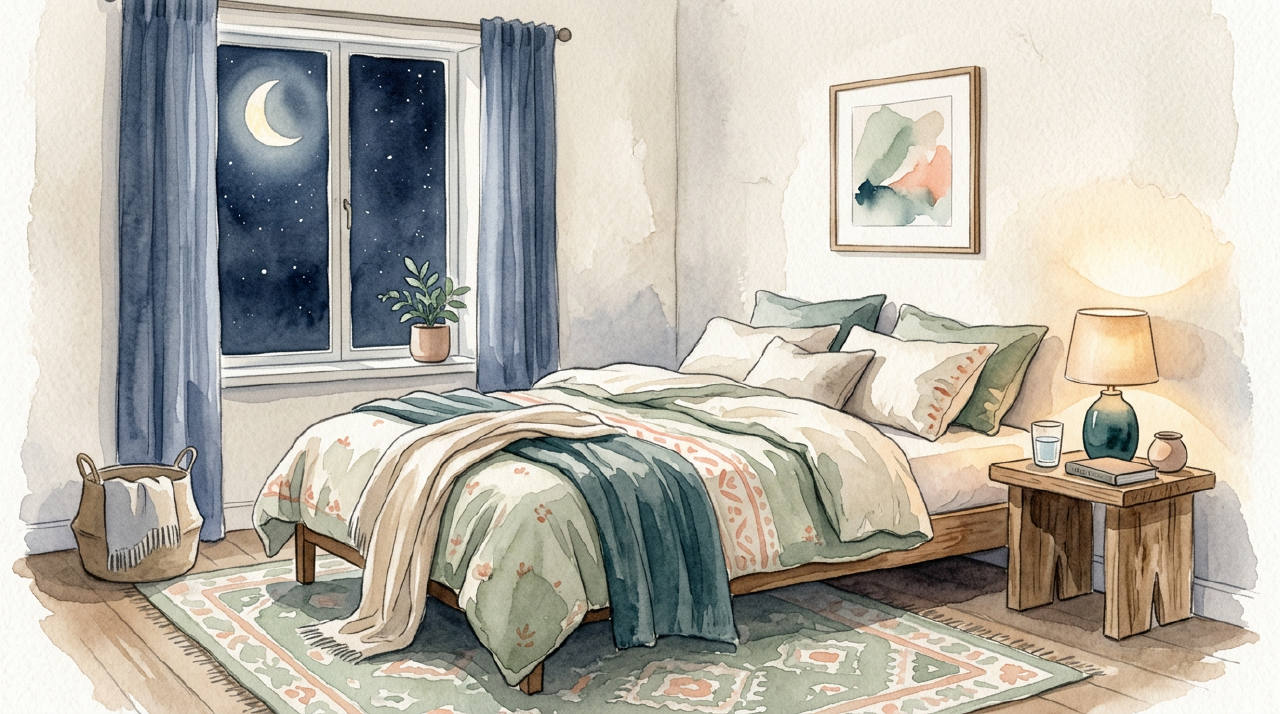
Your bedroom should be optimized for one thing: sleep.
- Dark: Use blackout curtains or an eye mask to block out all light. Even small amounts of light can disrupt sleep.
- Cool: The ideal temperature for sleep is between 60-67°F (15-19°C).
- Quiet: Use a white noise machine, a fan, or earplugs to mask disruptive sounds.
- Comfortable: Ensure your mattress and pillows are comfortable and supportive.
Step 6: Adjust Your Sleep Window
- Estimated Time: 5 minutes, once a week.
- Tools: Your sleep diary data.
- Key Tip: Be patient. This is a gradual process of earning back your time in bed.
After one full week of your new schedule, it's time to check in and possibly adjust. Calculate your average sleep efficiency for the past week. 📊
Sleep Efficiency % = (Total Time Asleep / Total Time in Bed) x 100
Sleep Efficiency Illustrated

Your Goal: > 85%

[ Before CBT-I: Low Efficiency ]
Time in Bed (8 hrs):   |================================|
Actual Sleep (5 hrs): |=================|---awake---|

[ During CBT-I: High Efficiency ]
Time in Bed (6 hrs):   |======================|
Actual Sleep (5.5 hrs):|====================| (consolidated)
Use this simple rule to adjust your sleep window for the following week:
- If your average sleep efficiency is 85% or higher: You've earned it! Add 15-20 minutes to your sleep window by going to bed earlier. (e.g., New bedtime 12:10 AM).
- If your average sleep efficiency is between 80-84%: Make no change. Keep your current sleep window for another week.
- If your average sleep efficiency is below 80%: Decrease your sleep window by 15-20 minutes (but never go below 5.5 hours).
Continue this weekly process of tracking, calculating, and adjusting. Over time, you will gradually expand your sleep window while maintaining a high sleep efficiency, leading to more consolidated, restful sleep.
Frequently Asked Questions
Isn't sleep restriction just a form of sleep deprivation?
It might feel that way for the first few days, but the goal is the opposite. It's a temporary strategy to reduce the time you spend awake in bed. By slightly increasing daytime sleepiness, it strengthens your sleep drive, helping you fall asleep faster and stay asleep more soundly. This consolidates your sleep, making it more restorative, even if it's shorter at first.
What if I get out of bed as instructed but still can't get sleepy?
This is common. The primary goal of getting out of bed isn't to magically make you sleepy; it's to break the connection between your bed and wakeful frustration. Continue your quiet, relaxing activity in another room until you feel the stirrings of sleepiness return, even if it takes a long time. The key is to only return to bed when you feel sleepy, reinforcing that the bed is a place for sleeping.
How long does it take for CBT-I to work?
Most people start to see noticeable improvements within 2 to 4 weeks, but the full benefits can take 8 weeks or more of consistent practice. It's a skill you're building. There will be good nights and bad nights along the way. The key is to stick with the principles, especially your fixed wake-up time, and trust the process.
When to See a Professional
This guide is a powerful starting point for implementing the behavioral principles of CBT-I. However, chronic insomnia can be complex and is sometimes linked to other medical or mental health conditions.
Please consult a doctor or a certified sleep therapist if:
- You see no improvement after trying these techniques consistently for several weeks.
- You suspect you might have another sleep disorder, such as sleep apnea (indicated by loud snoring, gasping for air) or restless legs syndrome.
- Your insomnia is accompanied by severe depression, anxiety, or trauma that feels unmanageable on your own.
- You are currently taking prescription sleep medication and want to taper off (this must be done under a doctor's supervision).
A professional can provide a formal diagnosis, rule out other conditions, and offer a more personalized and supportive CBT-I program.
Your journey to better sleep is a marathon, not a sprint. Be kind to yourself, celebrate small victories, and remember that restful nights are possible. For additional support on your journey, Araam offers guided meditations, progressive muscle relaxation exercises, and a journaling space to help you practice the cognitive and relaxation techniques outlined in this guide. We're here to help you find your peace, day and night. 🌿