Urge Surfing: The Mindfulness Technique That Beats Hard-to-Break Habits
It’s 9:30 PM. The house is quiet, the day is done, and you’ve settled onto the sofa to finally relax. And that’s when it arrives. At first, it’s just a whisper: a thought about the pint of rocky road
It’s 9:30 PM. The house is quiet, the day is done, and you’ve settled onto the sofa to finally relax. And that’s when it arrives. At first, it’s just a whisper: a thought about the pint of rocky road ice cream in the freezer. Then the whisper becomes a shout. You can almost taste the cold, creamy sweetness, feel the crunch of the almonds. Your body floods with a powerful, demanding sensation—an urge. You know you’ll feel regretful tomorrow, but the pull is almost magnetic. You feel like you have two choices: give in and eat the ice cream, or fight a miserable, white-knuckled battle against your own mind. But what if there’s a third option? What if, instead of fighting the wave or letting it pull you under, you could learn to ride it? This is the core idea behind urge surfing, a transformative mindfulness technique that offers a path to freedom from our most stubborn habits.
What Exactly Is Urge Surfing?
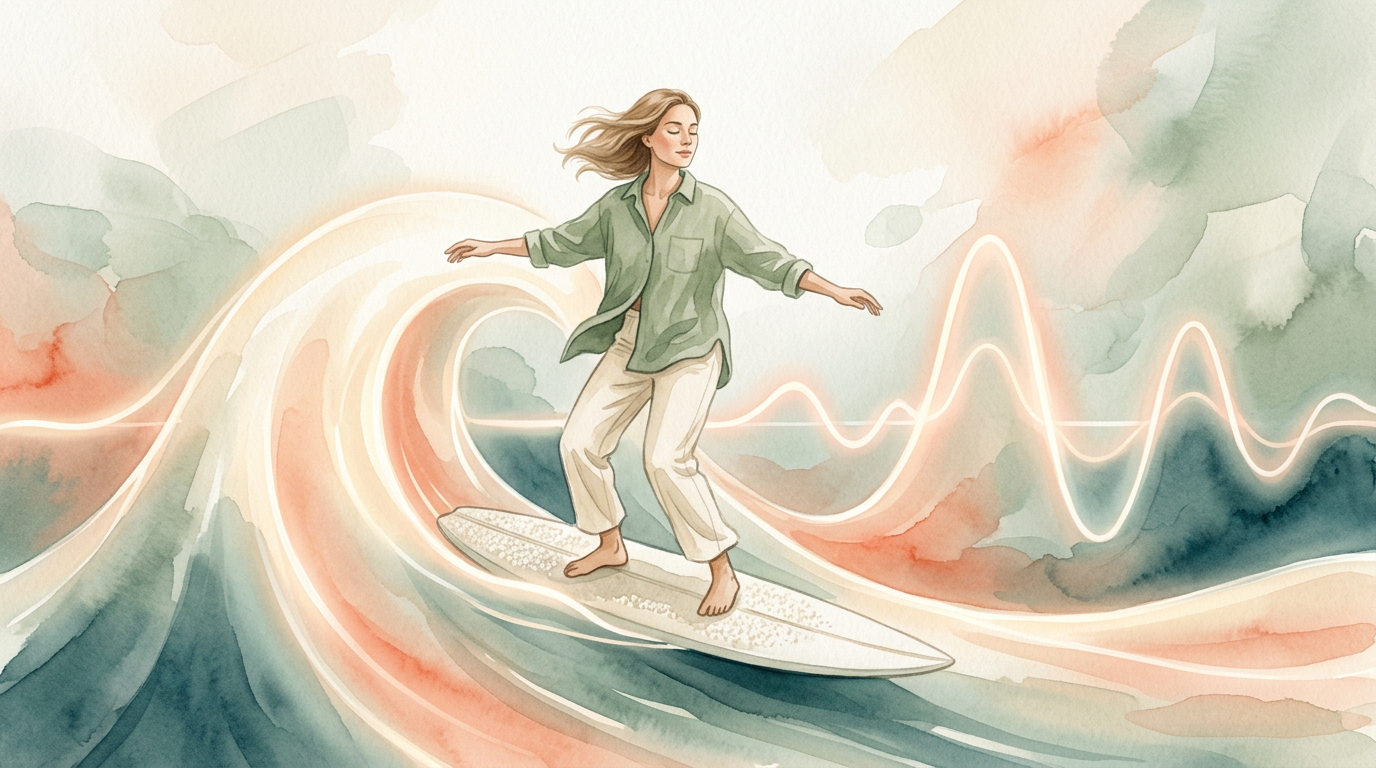
Urge surfing is a mindfulness technique where you mindfully observe your cravings and urges without judging them or acting on them. The practice involves treating an urge like a wave in the ocean: you notice it as it builds, watch it crest to its peak, and then observe it as it naturally subsides and dissipates on its own. Instead of trying to suppress the urge (which can often make it stronger) or immediately gratifying it (which reinforces the habit), you simply stay present with the physical and mental sensations until they pass.
The term was coined by the late psychologist Alan Marlatt, a pioneer in addiction research. He developed the technique as a relapse-prevention tool for individuals recovering from substance use disorders. He realized that a key skill for maintaining sobriety wasn't just avoiding triggers, but learning what to do when an urge inevitably arose. The practice has its roots in Acceptance and Commitment Therapy (ACT), a form of psychotherapy that encourages accepting uncomfortable thoughts and feelings rather than trying to eliminate them.
The core principle is simple but profound: you are not your urges. An urge is just a collection of thoughts, feelings, and physical sensations. By learning to surf it, you create a space between the impulse and your response, allowing you to choose a behavior that aligns with your long-term values and goals. 🌱
Where Do Urges Come From, Anyway?
To effectively surf an urge, it helps to understand what’s happening in your brain and body when one strikes. Urges aren't signs of moral weakness; they are neurological and physiological events, often rooted in the brain's very efficient, but sometimes unhelpful, habit-formation system.
At the heart of this system is a simple, powerful feedback loop: Trigger -> Behavior -> Reward.
-
Trigger (or Cue): This is the spark that ignites the urge. Triggers can be external or internal.
- External Triggers: Seeing a colleague light a cigarette, walking past a bakery, hearing the notification sound on your phone.
- Internal Triggers: Feelings of stress, boredom, loneliness, or even happiness can all act as triggers for certain behaviors.
-
Behavior: This is the action you take in response to the trigger, like smoking the cigarette, buying the pastry, or checking your social media feed.
-
Reward: This is the payoff. Your brain releases a flood of dopamine, a neurotransmitter associated with pleasure and motivation. This feels good, and your brain logs the experience: "Hey, that was great! Let's do that again next time we're in this situation."
Over time, this loop becomes an automated habit. The connection between the trigger and the urge becomes so strong that it feels instantaneous and overwhelming. Your brain is simply trying to be efficient, running a program it has learned leads to a reward. An urge is the brain's way of screaming, "Do the thing! Get the reward!" Understanding this demystifies the urge and turns it from a menacing monster into a predictable biological process.
An urge is only a suggestion from your brain, not a command from your boss. You don't have to obey. You have the power to observe it, learn from it, and let it pass. 🕊️
The 90-Second Rule: Riding the Wave of Emotion
One of the most empowering concepts related to urge surfing comes from Dr. Jill Bolte Taylor, a Harvard-trained neuroanatomist. After experiencing a massive stroke, she had the unique opportunity to observe her own brain function from the inside out. From her experience, she proposed that the physiological lifespan of an emotion, from trigger to dissipation, is only about 90 seconds.
When a trigger fires, it causes a cascade of chemicals to be released in your body, creating the physical sensations of an emotion or an urge—the tight chest, the churning stomach, the racing heart. According to Dr. Taylor, it takes about 90 seconds for your body to metabolize and flush out these chemicals.
So why does it feel like an urge lasts for hours? Because after the initial 90-second wave, we often reboot the cycle with our thoughts. We think about how good it would feel to give in, or how terrible it feels to resist. Each thought can act as a new trigger, re-stimulating the chemical cascade and starting the 90-second clock all over again. This creates a loop of re-triggering that makes the urge feel persistent and unbearable.
Urge surfing breaks this cycle. By focusing on the raw physical sensations of the urge and letting the thoughts drift by without engaging them, you allow the 90-second process to complete itself naturally. 💧
The Urge Curve in Action
You can visualize this 90-second rule with a simple chart. The key is to remember that what goes up must come down.
Intensity of Urge
  ^
  |
  |                / peak \
  |               /        \
  |              /          \
  |             /            \
  |            /              \
  |           /                \
  |          /                  \
  +---------|--------------------|--------------------> Time (approx. 90 seconds)
          Build               Crest               Fall
By learning to ride out this curve without acting, you teach your brain a new lesson: you can experience a trigger and not get the reward, and you survive. Over time, this weakens the trigger-behavior connection.
[[IMAGE:fig2|A split-panel infographic. Left panel shows a person struggling against a big, chaotic wave labeled "Resisting." Right panel shows a person giving in and being pulled under a wave labeled "Indulging." Center panel, larger than the others, shows a person calmly surfing a smooth wave labeled "Observing."|A three-panel graphic comparing responses to an urge. The left panel, titled "Resisting," depicts a person being thrashed by a violent, messy wave. The right panel, titled "Indulging," shows a person sinking beneath a wave, looking defeated. The larger, central panel, titled "Urge Surfing," shows a calm person skillfully riding a clean, manageable wave, demonstrating balance and control.]]
Urge Surfing vs. Fighting vs. Giving In: A Comparison
To truly appreciate the power of urge surfing, it’s helpful to compare it to the two most common ways people deal with urges: fighting them with willpower (resisting) or simply giving in (indulging).
| Feature | Giving In (Indulging) | Fighting (Resisting) | Urge Surfing (Observing) |
|---|---|---|---|
| Action | Immediately acting on the urge. | Using willpower to suppress the urge. | Observing the urge without acting on it. |
| Mindset | "I can't help it." "I deserve it." | "This is bad. I must stop this feeling." | "This is an urge. It's uncomfortable, but it will pass." 🧘 |
| Energy Use | Low initial effort, high "cleanup" effort (guilt, shame). | Very high mental effort ("white-knuckling"). | Moderate initial effort, decreasing with practice. |
| Short-Term Outcome | Temporary pleasure or relief, followed by guilt, shame, or physical discomfort. | Increased tension, stress, and mental exhaustion. The urge may intensify (rebound effect). | Discomfort that gradually subsides. A sense of empowerment and self-efficacy. |
| Long-Term Impact | Strengthens the habit loop. Decreases self-trust and self-esteem. | Often leads to burnout and eventual "willpower failure," reinforcing feelings of helplessness. | Weakens the habit loop. Builds self-awareness, resilience, and self-trust. ✨ |
How to Practice Urge Surfing: A Step-by-Step Guide
Urge surfing is a skill, and like any skill, it gets easier with practice. Here is a step-by-step guide you can use whenever a strong urge arises.
-
Acknowledge and Name It. The moment you notice the urge, mentally say to yourself, "Ah, here is an urge to [smoke / check my phone / eat a cookie]." This simple act of naming creates a bit of distance and shifts you from being in the urge to observing it.
-
Settle Into Your Body. You don't have to sit in a formal meditation pose. Just pause whatever you are doing. You can stand still, sit in a chair, or even lie down. Take a moment to feel your feet on the floor or your body on the chair. This helps ground you in the present moment.
-
Get Curious and Observe. Turn your attention inward. Scan your body from head to toe and notice, with the curiosity of a scientist, where the urge is showing up as a physical sensation.
- Is your stomach clenching?
- Is there a tightness in your chest or throat?
- Are your hands tingling?
- Is there a feeling of emptiness or tension in a specific part of your body?
- Describe these sensations to yourself without judgment (e.g., "tightness," "vibrating," "hollow," "warm").
-
Breathe With the Sensations. Don't try to breathe the sensations away. Instead, imagine your breath flowing into and around the areas of tension or discomfort. On the inhale, imagine creating space around the sensation. On the exhale, imagine the sensation softening, even just a little. 🌿
-
Notice the Crest and Fall. Like a wave, the urge will build in intensity. This peak can feel very powerful. Remind yourself that this is the crest of the wave. Your only job is to stay balanced on your "surfboard" of awareness and keep breathing. Notice the moment the intensity stops growing. Then, notice as it begins to subside. Track the sensations as they fade away.
-
Reflect and Reinforce. Once the wave has passed and the urge has significantly weakened or disappeared, take a moment to acknowledge what you just did. Congratulate yourself. You successfully surfed an urge! This reinforces a new belief: "I can handle this feeling. I am in control."
Urge Surfing in Real Life: Practical Examples
The theory is great, but what does this look like in practice? Let's apply the steps to three common, hard-to-break habits.
Example 1: The Cigarette Craving After a Meal
- Trigger: Finishing dinner, a long-established cue for a cigarette.
- The Urge: A powerful physical and mental pull. Your mind says, "A cigarette would be perfect right now." You feel a familiar tension in your shoulders and a hollow feeling in your chest.
- Surfing the Urge:
- Acknowledge: "This is a craving for a cigarette."
- Settle: You remain seated at the table instead of immediately getting up to go outside. You plant your feet on the floor.
- Observe: You close your eyes for a moment. You notice the tightness in your chest is a distinct, vibrating sensation. Your mouth feels watery. Your hands feel restless. You just notice this without judging.
- Breathe: You take a slow breath, imagining it moving into your chest, surrounding the vibrating feeling. As you exhale, you imagine the tension softening.
- Notice the Crest: The urge intensifies. Your mind screams, "Just one!" This is the peak. You focus intensely on the feeling of your feet on the floor. You notice the urge is no longer growing. A moment later, you notice the tightness in your chest has lessened by maybe 5%.
- Reflect: A few minutes later, the craving has subsided into a quiet background noise. You feel a sense of calm and quiet pride. You did it. 💡
Example 2: The Late-Night Urge to Binge-Eat
- Trigger: Feeling bored, lonely, and slightly stressed after a long day.
- The Urge: An intense craving for something sweet and fatty. A frantic energy and a feeling of emptiness in your stomach, even though you're not physically hungry.
- Surfing the Urge:
- Acknowledge: "I am feeling a strong urge to binge on cookies."
- Settle: You go to the living room, turn down the lights, and lie down on the rug.
- Observe: You scan your body. The "emptiness" isn't in your stomach; it's a cold, hollow feeling in your solar plexus. Your legs feel restless. Your thoughts are racing, listing all the delicious things in the kitchen. You let the thoughts be there, but you keep your attention on the physical feelings.
- Breathe: You place a hand on your solar plexus and breathe into it. You don't try to make the hollow feeling go away, you just "be with it."
- Notice the Crest: The feeling becomes almost overwhelmingly uncomfortable. You want to jump up and run to the kitchen. This is the peak. You stay put, breathing. You notice that the feeling is just a sensation—it can't actually hurt you. Then, you feel a subtle shift. The frantic energy begins to calm.
- Reflect: After about ten minutes of gentle observation and breathing, the urge has transformed into a simple feeling of sadness and tiredness. The frantic energy is gone. You decide to make a cup of herbal tea and go to bed. You feel a deep sense of self-respect.
Example 3: The Compulsion to Scroll Through Social Media
- Trigger: A moment of downtime while waiting for the microwave, or hitting a tough spot in a work project.
- The Urge: An almost unconscious reflex to pull out your phone. A tingly, restless feeling in your fingers and a mental "itch" to see what's new.
- Surfing the Urge:
- Acknowledge: "There's the urge to check Instagram."
- Settle: You deliberately place your phone face down on the counter, a few feet away. You stand still and notice your posture.
- Observe: You notice the restlessness in your hands. You feel a slight tension in your jaw. Your mind feels "fuzzy" and wants a distraction. You observe these micro-sensations.
- Breathe: You take one deep, deliberate breath and look out the window.
- Notice the Crest: The mental itch feels strongest for about 20-30 seconds. Your thumb might even twitch. You resist the urge to judge this, simply noting, "This is what the urge feels like." Then, the microwave beeps. The moment passes. The urge has significantly faded.
- Reflect: You eat your lunch without your phone. You notice the taste of your food more. You realize how automatic that habit was and feel empowered by having made a conscious choice. 📊
Frequently Asked Questions
What if my urge lasts way longer than 90 seconds?
This is a common experience, especially when you're first learning. Remember Dr. Taylor's insight: the initial physiological wave is about 90 seconds, but our thoughts about the urge can re-trigger the cycle. If an urge feels like it's going on forever, gently check in with your thoughts. Are you arguing with the urge? Fantasizing about giving in? Berating yourself? Each of these thoughts can be a new log on the fire. When you notice this, gently guide your attention back to the raw, physical sensations in your body and your breath.
Is urge surfing just for addictions like smoking or overeating?
Not at all! Urge surfing is a versatile life skill that can be applied to any impulsive or habitual behavior you want to change. This includes:
- Procrastination (surfing the urge to do something else instead of your task)
- Compulsive shopping (surfing the urge to click "buy now")
- Anger outbursts (surfing the urge to yell or say something hurtful)
- Anxious habits like nail-biting or skin-picking
Any time there is a gap between an impulse you feel and the person you want to be, urge surfing can be a bridge.
This sounds really uncomfortable. Am I doing it wrong?
If it's uncomfortable, you're doing it exactly right! The goal of urge surfing isn't to feel good; it's to get good at feeling. You are intentionally stepping into discomfort to learn that you can tolerate it. The magic is in the discovery that these uncomfortable feelings are temporary and not harmful. It will feel awkward and difficult at first, but with practice, your tolerance for discomfort will grow, and the power the urges have over you will shrink.
When to Seek Professional Support
Urge surfing is a powerful self-help technique for managing everyday habits and impulses. It can dramatically increase your sense of agency and self-control.
However, it is not a substitute for professional medical or psychological treatment. If you are struggling with a severe substance use disorder, an eating disorder, self-harm, or overwhelming mental health challenges, it is crucial to seek support from a qualified professional. A therapist, counselor, or doctor can provide a safe, structured environment for healing and help you develop a comprehensive treatment plan. Urge surfing can be an excellent supplement to this professional care, but it should not be your only tool in these situations.
For further guidance on building mindfulness skills and exploring your habits in a supportive space, the team at Araam is here to help. Explore our guided sessions on mindfulness and habit formation to continue your journey of self-discovery and growth.