Urge Surfing: The Mindfulness Technique That Beats Hard-to-Break Habits
It starts as a whisper, a faint tug at the edge of your awareness. Maybe it’s the ghost of a cigarette on your lips, the siren song of the pantry after a long day, or the twitch in your thumb that beg
It starts as a whisper, a faint tug at the edge of your awareness. Maybe it’s the ghost of a cigarette on your lips, the siren song of the pantry after a long day, or the twitch in your thumb that begs to unlock your phone and scroll into oblivion. Within moments, that whisper becomes a roar. The pull is undeniable, a physical and mental craving that promises immediate relief if you just give in. We’ve all been there, caught in a battle of wills against our own impulses, often feeling like we're losing the fight. But what if the goal wasn’t to fight the wave of desire, but to learn how to ride it? This is the core of urge surfing, a powerful mindfulness technique that can fundamentally change your relationship with hard-to-break habits, transforming struggle into skill.
What Is Urge Surfing? A Gentle Introduction
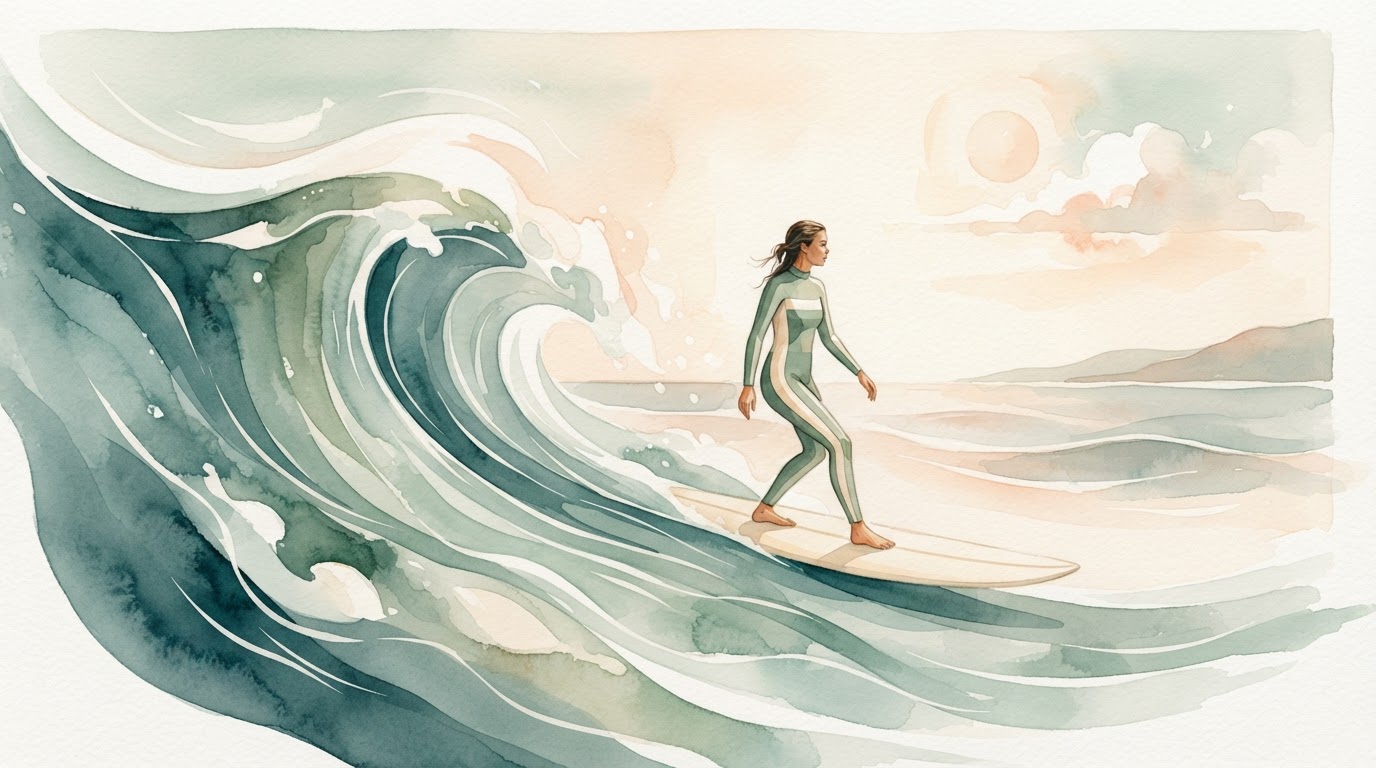
Urge surfing is a mindfulness-based technique where you mindfully observe your cravings and urges without acting on them. Instead of trying to suppress, ignore, or fight an urge, you treat it like a wave in the ocean: you notice its arrival, observe its peak, and ride it out until it naturally subsides. The practice is rooted in Acceptance and Commitment Therapy (ACT) and was popularized by the late psychologist Alan Marlatt for addiction relapse prevention.
The central idea is that urges are temporary natural phenomena. They arise, build in intensity, crest, and then inevitably fall away on their own if we don't "feed" them by acting on them. By surfing the urge, you learn through direct experience that you are not your urge, and you don't have to be controlled by it. You learn that you can, in fact, tolerate the discomfort. It’s a profound shift from a battle against yourself to a practice of compassionate observation. 🕊️
The Science Behind the Urge: Where Do Cravings Come From?
To effectively surf an urge, it helps to understand what’s happening in your brain and body. Cravings aren’t a sign of moral failure or a lack of willpower; they are deeply rooted in our neurobiology.
The Brain's Habit Loop
Most of our persistent urges are part of a neurological "habit loop," a three-step process described by Charles Duhigg in The Power of Habit:
- The Cue: A trigger that tells your brain to go into automatic mode and which habit to use. This could be a time of day (your 3 PM energy slump), a location (passing a coffee shop), an emotional state (feeling stressed or bored), or the presence of certain people.
- The Routine: This is the physical or emotional action you take—the habit itself. It might be lighting a cigarette, opening the fridge, or grabbing your phone.
- The Reward: This is what satisfies your brain and tells it that this particular loop is worth remembering for the future. The reward is often a flood of dopamine, the "feel-good" neurotransmitter, which provides a sense of pleasure or relief.
This loop is incredibly efficient, which is why habits are so hard to break. Your brain has learned that Cue X + Routine Y = Reward Z. Urge surfing is a technique that directly intervenes in this loop by changing the routine. You experience the cue, but instead of automatically performing the old routine, you introduce a new one: mindful observation.
The 90-Second Rule ✨
One of the most empowering concepts behind urge surfing comes from Dr. Jill Bolte Taylor, a Harvard-trained neuroanatomist. In her book My Stroke of Insight, she explains that when a person has a reaction to something in their environment, there’s a 90-second chemical process that happens in the body.
"When a person has a reaction to something in their environment, there’s a 90-second chemical process that happens in the body; after that, any remaining emotional response is just the person choosing to stay in that emotional loop."
What does this mean for your urges? The initial, raw, physiological component of a craving—the rush of adrenaline, the clenching in your stomach, the tension in your shoulders—lasts only about 90 seconds. After that point, the intensity is sustained by the story you tell yourself about the urge. Thoughts like, "I can't stand this feeling," "I need this to feel better," or "It will just get worse until I give in," are what keep the wave from cresting and subsiding. Urge surfing teaches you to observe the raw 90-second sensation without getting caught up in the story, allowing the chemical process to complete its cycle naturally.
Here’s a simple visualization of what that 90-second curve feels like:
        Urge Intensity
             ^
             |
             |           /Peak Intensity\
             |          /                \
             |         /                  \
 Rising -----|--------/                    \-------- Subsiding
 Sensation   |       /                      \
             |      /                        \
             |_____/__________________________\____________>
             0s    30s       60s        90s        120s
                          Time (approx.)
📊 This chart shows how an urge, when not acted upon, will naturally rise, peak, and fall away, often within a couple of minutes. Your job is simply to stay on the board and ride it out.
Urge Surfing vs. Resisting: A Crucial Distinction
You might be thinking, "Isn't this just another way of saying 'resist the urge'?" Not at all. The internal experience and long-term outcomes of resisting versus surfing are worlds apart. Resisting, or "white-knuckling," is an act of force. Surfing is an act of finesse.
Let's compare them side-by-side:
| Aspect | Resisting (White-Knuckling) | Urge Surfing (Mindful Observation) |
|---|---|---|
| Mindset | "I must fight this feeling! It's bad and I have to crush it." | "An urge is here. I'm curious about it. I can observe it." |
| Mental Action | Suppression, distraction, arguing with yourself, self-criticism. | Acknowledgment, acceptance, investigation, non-judgment. |
| Physical Sensation | Creates more tension. Leads to clenching, bracing, shallow breath. | Works with the sensation. Encourages deep breathing and relaxation. |
| Emotional Experience | Stressful, exhausting, frustrating. Often involves shame. | Calming, empowering, compassionate. Builds self-trust. |
| Relationship to Urge | The urge is an enemy to be defeated. | The urge is a temporary visitor to be observed. |
| Long-Term Outcome | Can deplete willpower, leading to an eventual "snap" or rebound. | Rewires the brain's response to cues, weakening the urge over time. |
Resisting an urge is like trying to hold a beach ball underwater. It takes a tremendous amount of energy, and the moment your focus wavers, the ball shoots to the surface with even more force. Urge surfing is like letting the beach ball bob on the waves next to you. You see it, you acknowledge it's there, but you don't engage in a power struggle with it. Eventually, a current carries it away.
[[IMAGE:fig2|A split-panel image. On the left, a person is struggling to hold a beach ball underwater, looking stressed and tense. On the right, the same person is calmly floating in the water while the beach ball bobs peacefully nearby.|A diptych illustration. The left panel shows a person with a strained expression, using all their effort to hold a colorful beach ball under the water's surface. The right panel shows the same person floating peacefully, with the beach ball bobbing gently beside them.]]
How to Urge Surf: Your Step-by-Step Guide 🧘
Urge surfing is a skill, and like any skill, it gets easier with practice. The next time you feel a strong craving begin to build, try walking through these steps. You can do this with your eyes open or closed, sitting or standing—whatever helps you focus inward.
-
Acknowledge and Name the Urge. The moment you notice the craving, pause. Instead of immediately reacting, simply say to yourself, "Ah, the urge to [smoke/eat/scroll] is here." Naming it creates a small but crucial space between you and the impulse. You are the observer, not the urge itself.
-
Get Curious About the Physical Sensations. 💧 Turn your attention inward. Where do you feel this urge in your body? Scan from head to toe. Is it a tightness in your chest? A hollow feeling in your stomach? Restlessness in your hands? Tingling in your scalp? Describe these sensations to yourself with neutral, objective language. For example: "I feel a buzzing energy in my fingers," or "There is a warm, pulling sensation in my gut." Avoid judgmental words like "awful" or "unbearable."
-
Breathe Into the Sensations. Your breath is your surfboard. Take slow, deep, deliberate breaths. As you inhale, imagine your breath flowing to the areas where you feel the urge most intensely. As you exhale, imagine softening and creating space around those sensations. Don't try to breathe the feeling away; simply breathe with it. This anchors you in the present moment and calms your nervous system.
-
Ride the Wave. Continue to notice the sensations as they change. They will likely shift, moving around your body, growing stronger, and then weaker. This is the core of surfing. You are just watching the wave of sensation as it builds to its peak (the crest) and then begins to recede. Remind yourself, "This is just a wave of sensation. It will pass." Notice the stories your mind might be telling you ("Just one bite won't matter") and let them go, returning your focus to the physical sensations of the present moment.
-
Notice the Aftermath. As the urge subsides, take a moment to notice what that feels like. Acknowledge that you successfully rode the wave without being wiped out. This final step is crucial for learning. You have just given your brain new, powerful evidence that you can, in fact, survive an urge without giving in. This builds self-efficacy and weakens the old habit loop.
Urge Surfing in Real Life: Practical Examples
Let's see how this plays out with three common, hard-to-break habits.
Surfing the Urge to Smoke
- The Cue: You just finished a meal, a classic trigger for many smokers.
- The Urge: Your brain screams for nicotine. You feel a knot in your stomach and your hands feel empty and restless. Your mind starts bargaining: "Just one puff to take the edge off."
- The Surf: Instead of reaching for a cigarette, you close your eyes for a moment. You name it: "This is the urge to smoke." You focus on your hands. What does "restless" actually feel like? A tingling? A vibration? You breathe into your stomach, noticing the "knot" without trying to undo it. You ride out the peak intensity, which feels like a strong pull in your chest. You keep breathing. After a minute or two, you notice the knot has loosened, and the restlessness in your hands has faded to a faint hum. The wave has passed. 🌿
Surfing the Urge to Overeat
- The Cue: It’s 9 PM. You feel bored and a little lonely after a stressful day.
- The Urge: A powerful craving for ice cream hits you. It’s not physical hunger; it’s a desire for comfort. You can almost taste it. Your mouth waters, and you feel antsy.
- The Surf: You pause with your hand on the freezer door. "Okay, the urge to eat for comfort is here." You sit down for a moment and check in with your body. You notice a hollow feeling in your chest (loneliness) and a buzzing tension in your jaw (stress). You label these feelings. You breathe into your chest, not to fix the loneliness, but just to be with it. You allow the mental image of the ice cream to be there without needing to make it real. You notice the craving peaks, your mind yelling, "You deserve this!" and then, as you continue to breathe and observe, the intensity slowly fades. You realize what you really needed was a moment of quiet self-compassion, not sugar.
Surfing the Urge to Scroll
- The Cue: You're waiting in line at the grocery store, a moment of unstructured time.
- The Urge: Your thumb automatically moves toward your phone. You feel a pull to check social media, to fill the "empty" space with information and stimulation. It feels like a mental itch.
- The Surf: You consciously place your phone back in your pocket. "The urge to scroll." You notice the feeling. It's a fidgety energy, a sense of impatience. Where is it? In your hands, your eyes, your brain? You focus on your breath instead. You look around the store. You notice the colors of the vegetables, the sound of the checkout scanner, the feeling of your feet on the floor. You're simply present. The mental itch starts to fade. You realize the world didn't end because you weren't online for three minutes. The wave passes, and you feel surprisingly calm. 💡
Frequently Asked Questions
What if the urge is too strong and I give in?
This is completely normal, especially when you're just starting. The goal of urge surfing isn't perfection; it's practice. If you give in to an urge, treat it as a learning opportunity, not a failure. Get curious: What were the circumstances? What story was my mind telling me? Every urge, whether you surf it successfully or not, is a chance to gather more data about yourself. Be kind, and simply commit to trying again on the next wave.
How long does it take for urge surfing to work?
Urge surfing provides an immediate alternative to acting on an urge, so in one sense, it "works" from the very first try. However, weakening a long-standing habit takes time and repetition. Think of it like building a muscle. The more you practice, the stronger your "observing self" becomes, and the weaker the automatic habit loop gets. Some people notice a significant decrease in the frequency and intensity of urges within a few weeks; for others, it may take longer. Consistency is more important than intensity.
Can I use this for things other than habits, like strong emotions?
Absolutely! Urge surfing is a versatile tool for emotional regulation in general. You can "surf" waves of anger, anxiety, sadness, or jealousy in the same way you surf a craving. The principle is identical: acknowledge the feeling, observe the physical sensations in your body without judgment, breathe with them, and allow the wave of emotion to move through you without lashing out or suppressing it. It's a powerful way to build emotional resilience.
When to See a Professional
Urge surfing is a powerful self-help technique, but it's not a substitute for professional medical or psychological care. If you are struggling with a severe addiction, an eating disorder, or if your urges are related to underlying trauma or a significant mental health condition like major depression or an anxiety disorder, it is essential to seek help from a qualified therapist, counselor, or doctor. They can provide a comprehensive diagnosis and a structured treatment plan tailored to your specific needs.
For daily support in building mindfulness skills like urge surfing, consider exploring Araam. Our app offers guided meditations and mindfulness exercises that can help you become more familiar with your inner landscape, teaching you to observe your thoughts and feelings with greater compassion and skill. Let us be your companion as you learn to navigate the waves of your own mind.