
Araam vs Notion vs Day One for Mental Health Journaling
The simple act of putting thoughts into words can be profoundly healing. For centuries, the private pages of a journal have served as a confidant, a space for untangling complex emotions, and a mirror
The simple act of putting thoughts into words can be profoundly healing. For centuries, the private pages of a journal have served as a confidant, a space for untangling complex emotions, and a mirror for self-discovery. Today, the pen and paper have evolved, and the modern journal lives on our phones and computers, offering features our ancestors could only dream of. But this new world presents a new challenge: with so many options, which digital space is truly the right one for your mental well-being? We'll explore three leading contenders—the AI-powered companion Araam, the infinitely flexible workspace Notion, and the classic digital diary Day One—to help you find the perfect home for your thoughts.

The Modern Journal: Why Your Choice of Tool Matters
The best journaling tool is the one you consistently use, but the tool you choose can significantly shape your journaling habit and its benefits. A blank page can be intimidating, while a structured prompt can feel restrictive. The right app removes friction and meets you where you are, transforming journaling from a chore into a reflective ritual. Your choice boils down to what you need most from your practice: a guide, a blank canvas, or a memory keeper.
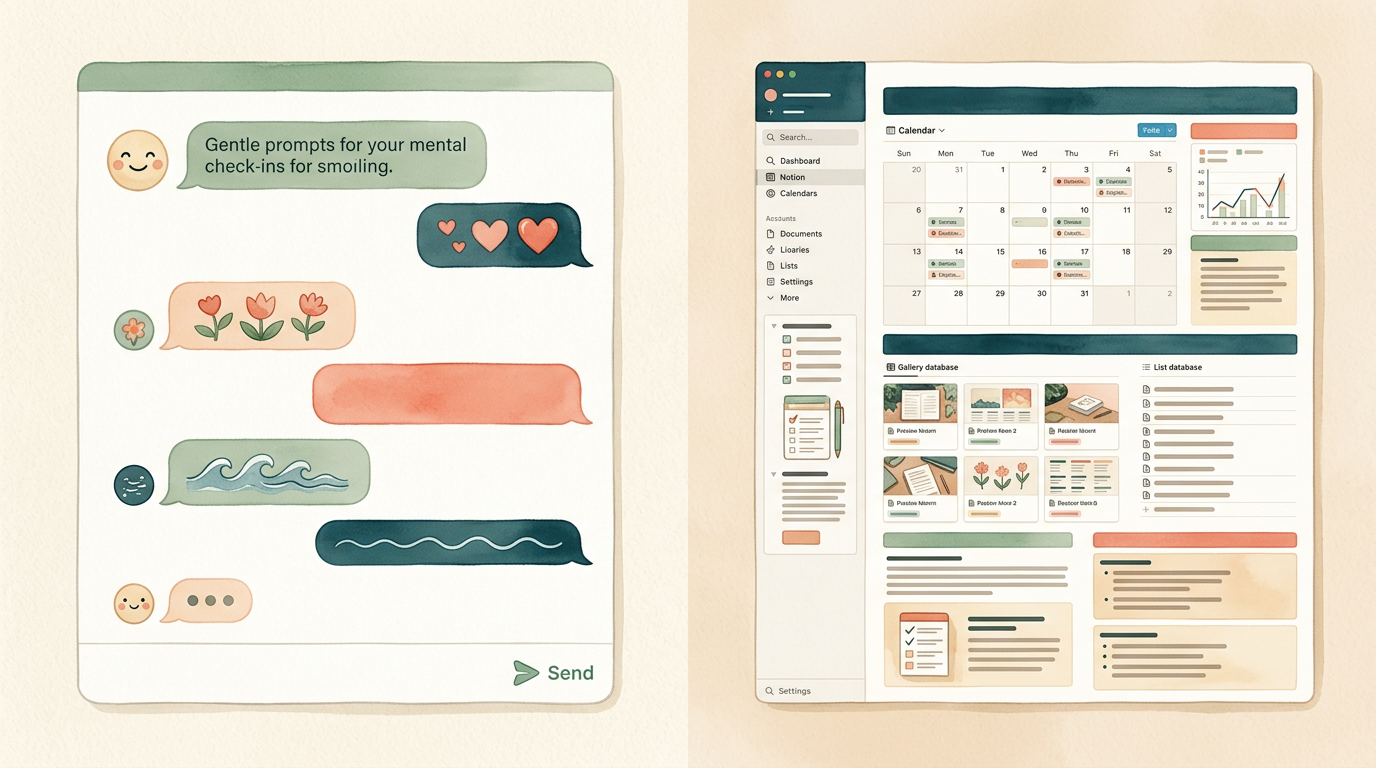
- The AI Companion (Araam): This approach is for those seeking a supportive, interactive experience. It’s like having a guide who asks gentle questions, helps you spot patterns in your moods and thoughts, and offers evidence-based exercises to help you feel better. It’s less about simple chronicling and more about active self-exploration and growth. 🌱
- The Infinite Workspace (Notion): This is for the builders, the organizers, the people who love to create their own systems. Notion provides the digital "Lego blocks" to construct a journaling system that is perfectly, uniquely yours, integrated with your habits, goals, and projects. It demands more upfront effort but offers unparalleled customization.
- The Dedicated Diary (Day One): This is for the purists and the sentimentalists. Day One focuses on beautifully capturing the moments of your life. It’s designed to be a private, elegant, and simple place to record your days, enriched with photos, location data, and weather, creating a rich tapestry of your personal history.
Each of these tools can be effective, but their philosophies differ greatly. Let's delve into what makes each one special.
Araam: The AI-Powered Wellness Companion
Araam is a mental wellness app that uses artificial intelligence to provide guided journaling prompts, empathetic chat-based check-ins, and personalized insights based on your entries. It's designed from the ground up to be a therapeutic tool, focusing not just on recording thoughts but on actively improving your mental health.
Think of Araam as a partner in your wellness journey. Instead of presenting you with a blank screen, it might ask, "What's on your mind today?" or offer a specific, structured exercise based on Cognitive Behavioral Therapy (CBT) principles to help you reframe a negative thought. Its core strength lies in its ability to listen and respond.
Key Strengths
The primary advantage of Araam is its guided nature. You're never alone with your thoughts. The AI is trained on therapeutic principles to help you dig deeper, identify cognitive distortions, and celebrate your progress. 💡
- Intelligent Insights: Over time, Araam can help you identify recurring themes, triggers, and patterns in your mood and thinking that you might not notice on your own.
- Structured Exercises: It offers a library of evidence-based techniques for managing anxiety, stress, sadness, and more.
- Low-Friction Entry: The conversational interface makes journaling feel less like writing an essay and more like texting a supportive, non-judgmental friend.
- Holistic View: Journaling is integrated into a broader ecosystem of wellness tools within the app, including mood tracking and mindfulness resources.
Potential Drawbacks
For those who want complete control over the look and feel of their journal, Araam might feel a bit constrained. Its focus is on function and therapeutic benefit over infinite aesthetic customization. Because it's a dedicated wellness app, it doesn't integrate with broader productivity systems like Notion.
Notion: The All-in-One Life OS
Notion is a productivity and note-taking app that can be molded into almost anything, including a highly sophisticated mental health journal. It’s not a journaling app by default; it's a powerful set of tools (databases, pages, templates) that you use to build your own journaling app.
For many, this is its magic. You can create a "Wellness Dashboard" that includes your daily journal, a mood tracker database, a habit tracker, a gratitude log, and links to your therapy notes—all in one place. The internet is filled with incredible, free templates that people have built for this very purpose. You can track your mood, energy levels, and daily activities and use Notion's database features to find correlations.
Key Strengths
Flexibility is Notion's superpower. You are the architect of your journaling experience. 📊
- Ultimate Customization: You can design your journal to look and function exactly how you want it, from simple daily entries to complex relational databases.
- Integration: Your journal can live alongside your work projects, academic notes, meal plans, and fitness logs, providing a truly holistic view of your life.
- Community & Templates: A vast community of users shares free, intricate templates, so you don't have to start from scratch.
- Productivity-Focused AI: Notion has integrated AI that can help summarize your entries, correct grammar, or even brainstorm ideas, though it's geared more toward productivity than therapeutic insight.
Potential Drawbacks
The "blank page problem" is very real with Notion. For someone in a moment of distress, the task of building a system—or even finding and tweaking a template—can feel overwhelming. It requires a certain amount of initial energy and tech-savviness. Furthermore, its security is standard for a cloud app but wasn't designed with the same privacy-first sensitivity as a dedicated mental health tool.
Day One: The Classic Digital Diary
Day One is an award-winning app that has been a leader in the digital journaling space for over a decade. Its philosophy is simple: provide a beautiful, private, and effortless place to capture your life as it happens. It excels at being a modern, multimedia-rich diary.
Opening Day One feels like opening a high-quality Moleskine notebook. The interface is clean, elegant, and focused on the writing experience. It automatically adds rich metadata to your entries, like the date, time, location, weather, and even what music you were listening to. This makes browsing your past a deeply evocative experience, allowing you to instantly transport yourself back to a specific moment.
Key Strengths
Day One's greatest strength is its beautiful simplicity and focus on memory-keeping. 🕊️
- Elegant User Experience: The app is a joy to use, with a clean design that gets out of your way and lets you focus on your thoughts.
- Rich Media Integration: Easily add photos, videos, audio recordings, and drawings to your entries.
- Automatic Context: The automatic metadata (location, weather, etc.) adds a powerful layer of context to your memories without any extra effort.
- Security: Day One offers robust security features, including end-to-end encryption and passcode/biometric protection, making it a truly private space.
Potential Drawbacks
While it does have templates and daily prompts, Day One is not an interactive or guided tool in the way Araam is. It doesn't analyze your entries to provide insights or offer therapeutic exercises. Its AI features are minimal. It is a fantastic tool for chronicling your mental state but offers less support in actively improving it.
Head-to-Head Comparison: Araam vs. Notion vs. Day One
To make the choice clearer, let's break down the key differences in a direct comparison table.
| Feature / Axis | Araam | Notion | Day One |
|---|---|---|---|
| 1. Core Purpose | AI Mental Wellness Companion | All-in-One Productivity "Life OS" | Elegant Digital Diary & Memory Keeper |
| 2. Structure & Guidance | High: Guided, conversational prompts & structured exercises. | Low/DIY: Infinitely flexible but requires user to build or find templates. | Medium: Offers simple templates and daily prompts but is mostly unstructured. |
| 3. AI Capabilities | ✨ Deep: AI-driven insights, pattern recognition, empathetic chat. Core to the experience. | Productivity-focused: Summarization, writing help, idea generation. An add-on feature. | Minimal: Basic "On This Day" features. No deep analysis or conversational AI. |
| 4. Security & Privacy | Very High: End-to-end encryption, anonymized data for AI, designed for sensitive information. | Standard: Standard cloud security. Not specifically designed for HIPAA-level privacy. | Very High: End-to-end encryption available, passcode/biometric lock. A core feature. |
| 5. Daily Journaling Flow | Low Friction: Conversational prompts make it easy and inviting to start. | Variable Friction: Can be overwhelming to set up, but low friction once a system is built. | Low Friction: Simple, clean interface for quick entries. Easy to form a daily habit. |
| 6. Cost & Pricing | Freemium with a Premium subscription for advanced features and unlimited AI. | Freemium. Paid plans for teams, advanced blocks, and unlimited AI usage. | Freemium with a Premium subscription for unlimited journals, media, and features. |
The Bottom Line: Which Is Best for Whom?
- Choose Araam if: You are specifically looking for a tool to help you understand and improve your mental health. You want guidance, therapeutic support, and a partner that helps you connect the dots in your emotional life. You value a low-friction, conversational approach over endless customization.
- Choose Notion if: You are a systems-thinker who wants to build a completely customized wellness dashboard that integrates with the rest of your life. You enjoy tinkering with technology and are willing to put in the upfront effort to create a space that is 100% yours.
- Choose Day One if: You want a beautiful, simple, and private place to chronicle your life and emotions. Your primary goal is memory-keeping and reflection, and you value an elegant user experience and strong security above all else.
"The sanctity of the journal is paramount. A digital tool must do more than just store our words; it must create a sanctuary, a space so private and secure that our truest thoughts feel safe to emerge."
Security and Privacy: Protecting Your Inner World
When journaling for mental health, you're sharing your most vulnerable thoughts. Therefore, the security and privacy of the platform you choose are not just a feature—they are the foundation of trust. An entry about a tough day at work is one thing; an entry about deep-seated anxiety, trauma, or relationship struggles is another.
Araam and Day One are the clear leaders here. Both offer end-to-end encryption (E2EE) as a cornerstone of their platforms. E2EE means that your data is encrypted on your device and can only be decrypted by you on your devices. Not even the companies themselves can read your journal entries. This is the gold standard for privacy and is essential for building the trust needed for deep, honest reflection. Araam takes it a step further by ensuring that any data used to train its AI models is fully anonymized and aggregated, severing any link back to an individual user.
Notion, while a powerful tool, uses standard cloud security. Your data is encrypted in transit and at rest on their servers, which is good, but it's not end-to-end encrypted. This means that, in theory, Notion employees could access your data under certain circumstances. For many journaling topics, this is perfectly fine. But for those dealing with highly sensitive mental health topics, the robust E2EE offered by Araam and Day One provides a critical extra layer of peace of mind. 💧
Here's a look at the evolution of journaling tools and their privacy considerations:
Journaling Tool Evolution & Privacy Spectrum

  [Low Privacy] <--------------------------------------> [High Privacy]

  Paper Diary     Early Blogs       Standard           E2EE Cloud         E2EE AI
  (Physical         (Public)      Cloud Apps           Journals         Companion
  Security)                         (Notion)          (Day One)           (Araam)

    |                 |                 |                  |                  |
Vulnerable to     Designed for      Convenient, but    Private by         Private,
loss/theft,       public view       company could      design, no         secure, and
but offline.                        potentially access.  access by co.    intelligently
                                                                          supportive.
Frequently Asked Questions (FAQ)
Can I import my old journals into these apps?
Araam: Currently, Araam focuses on creating new insights and doesn't have a direct import feature for bulk text files, though this is something many users are interested in. Notion: Yes, Notion is excellent for this. You can easily copy and paste or import Markdown and text files to archive your old journals. Day One: Yes, Day One has robust import features, allowing you to bring in entries from other services, plain text files, and more, making it a great option for consolidating your journaling history.
Is a free plan good enough to start with?
Absolutely. All three apps offer very generous free tiers. You can use the free versions of Araam, Notion, and Day One indefinitely to see which style fits you best. Free plans are a perfect way to test-drive the core experience before committing to a premium subscription for more advanced features like unlimited AI in Araam, unlimited blocks in Notion, or unlimited journals in Day One.
What if I don't feel like "writing" every day?
That's completely normal, and modern tools are built for this!
- In Araam, you can simply do a quick mood check-in or have a short chat with the AI, which can be less pressure than a full entry. 🧘
- In Day One, you can just snap a photo and add a one-line caption. The app will log the rest.
- In Notion, you can design your journal with simple checkboxes for habits or a single-word mood entry. The key is consistency, not length.
When to See a Professional
Journaling is a powerful tool for self-awareness and emotional regulation, but it is not a substitute for professional mental health care. These apps can be a fantastic supplement to therapy, but they are not therapy themselves.
If you are experiencing persistent feelings of sadness, anxiety, or hopelessness that interfere with your daily life, or if you are having thoughts of harming yourself or others, it is crucial to seek help from a qualified professional. A therapist, counselor, or psychiatrist can provide a diagnosis and create a personalized treatment plan. Think of your journaling app as a helpful companion on your journey, and a mental health professional as your expert guide.
Choosing a journaling app is a personal decision that depends on your unique needs and goals. If you're drawn to the idea of a supportive, intelligent guide that actively helps you navigate your inner world, we hope you'll explore what Araam has to offer. Start a conversation, try a guided exercise, and see if our gentle, evidence-based approach feels right for you. Your journey to wellness deserves a dedicated companion. 🌿